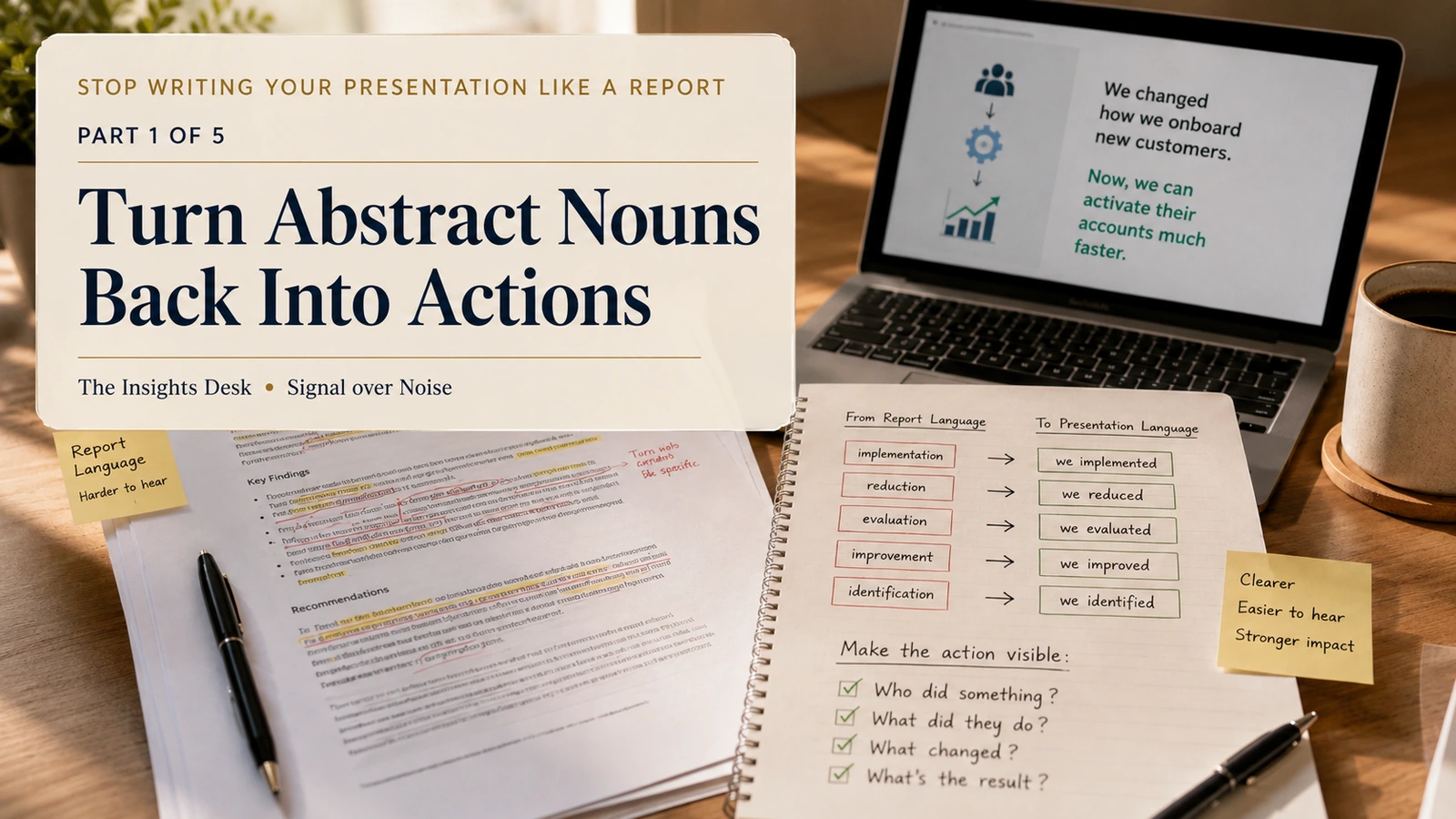
Here is a perfectly respectable sentence:
The implementation of the revised customer onboarding process resulted in a significant reduction in the average time required for account activation.
The grammar is fine. The vocabulary is professional. Put it into a report and nobody is calling the language police.
Now imagine hearing it during a presentation.
Who did something?
What did they do?
What changed?
You can figure it out. But that is the problem: you have to figure it out.
A reader can stop, look back, and unpack a complicated sentence. A presentation audience normally hears the sentence once, while also looking at your slides, thinking about your last point, taking notes, and wondering whether the coffee machine outside is still working.
Presentation language has to survive that environment.
Short answer: If an important action is hidden inside an abstract noun, turn it back into a verb and make the actor clear. Presentation language is easier to follow when listeners can hear who did what and what changed.
One useful place to start is with the verbs.
What happened to the verbs?
Formal English has a useful trick: it can turn actions into things.
We implement something.
That becomes:
the implementation
We evaluate something.
That becomes:
the evaluation
Sales improve.
That becomes:
an improvement in sales
Linguists call this nominalization. You do not need to remember that word unless knowing it brings you joy.
What matters is what happens to the sentence.
An action that was once carried by a clear verb gets packed inside a noun.
That can be useful in reports, academic papers, technical documents, and formal summaries. Written language often needs to compress information.
But presentations have a different problem.
Your audience has to understand the idea as it arrives.
When important actions disappear into abstract nouns, listeners may have to reconstruct what happened.
The useful question is not:
“How do I remove all the formal words?”
It is:
Is there an action hiding inside this sentence that would be clearer as a verb?
Let’s try it.
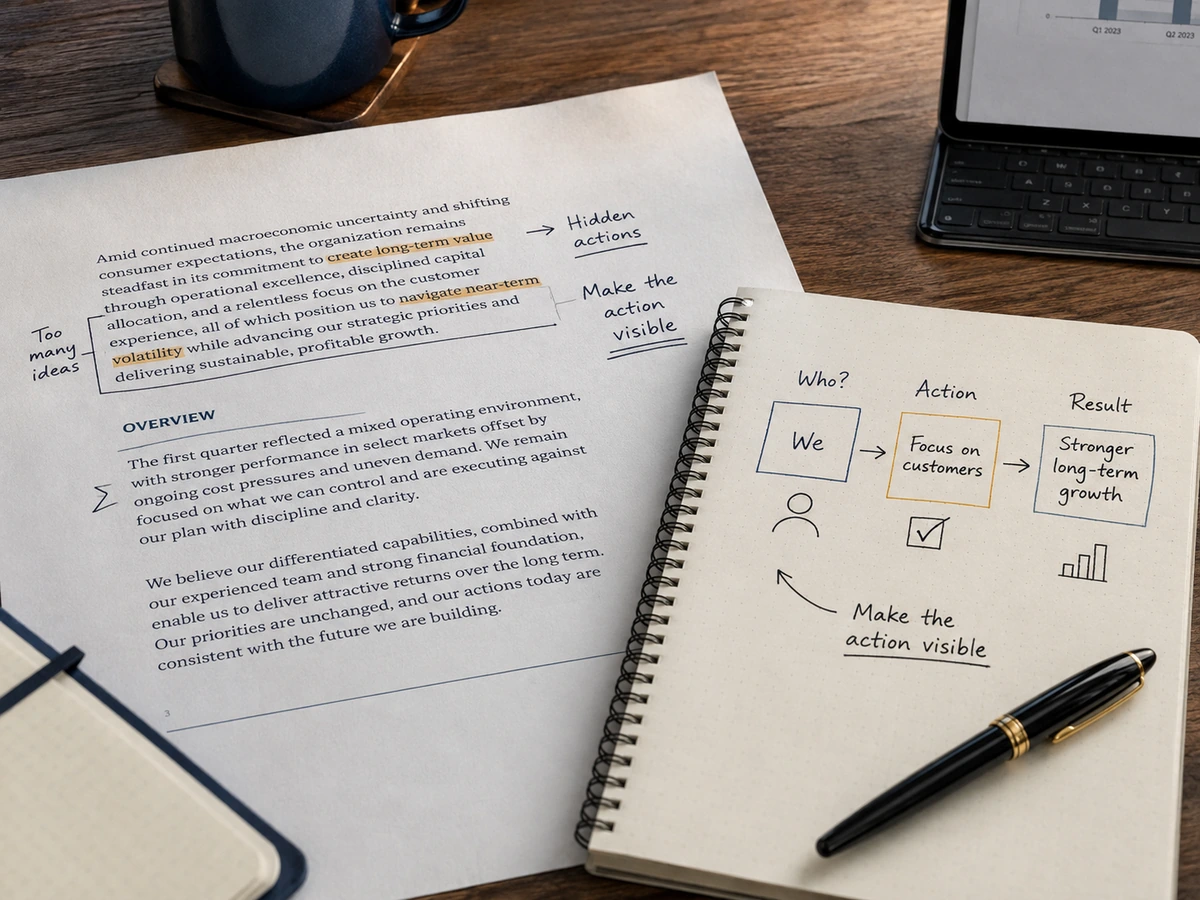
Example 1: A business update
Report
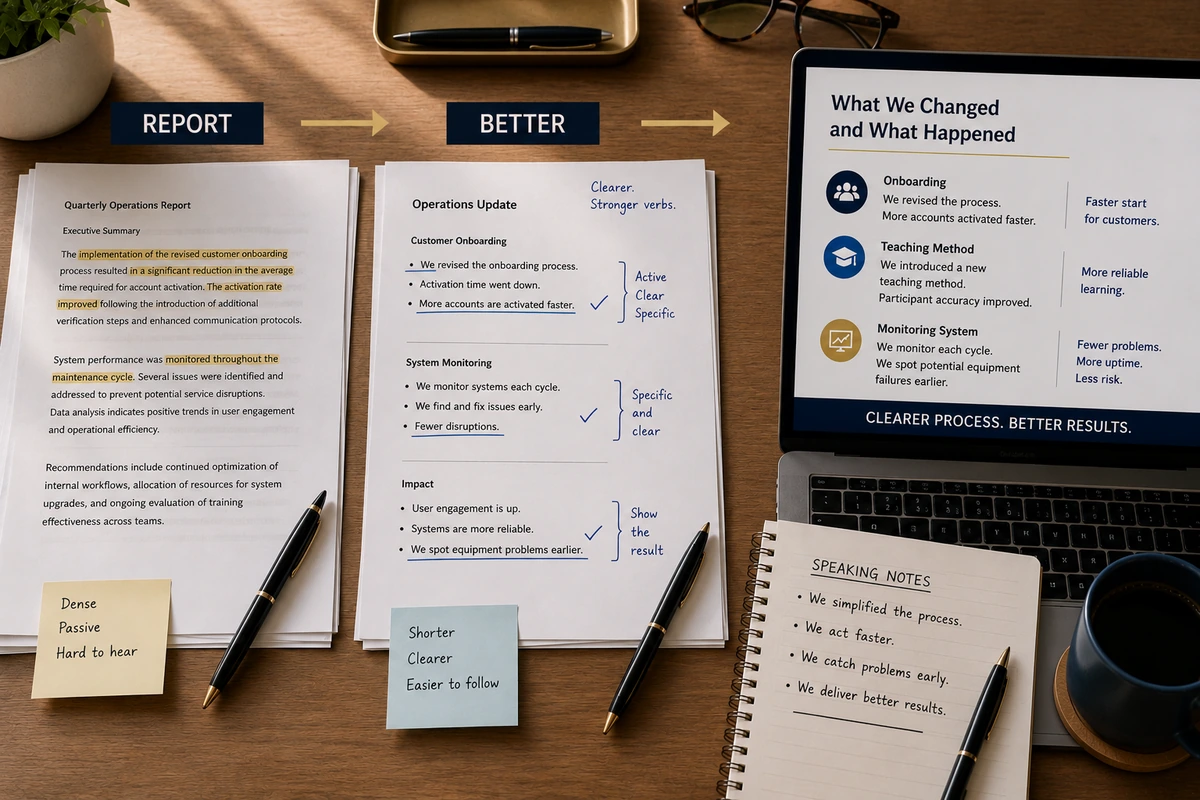
The implementation of the revised customer onboarding process resulted in a significant reduction in the average time required for account activation.
It is doing a report's job: compressing several pieces of information into one formal sentence.
Better
The revised onboarding process significantly reduced the time required to activate new accounts.
Already easier.
The action is becoming clearer:
the process reduced the time
But it still sounds more like something written for a document than something one person would naturally say to another.
Presentation-ready
We changed how we onboard new customers. Now, we can activate their accounts much faster.
Listen to what changed.
The report version gives us:
implementation → reduction → activation
The presentation version gives us:
we changed → we onboard → we activate
The actions are visible again.
And the listener gets the idea in a simple sequence:
We changed something. Here is what happened.
That is the real improvement.
It is not merely a shorter sentence.
It is clearer action.
Example 2: Academic research
This problem is especially common in academic presentations because the source material was often written for a paper first.
Report
The evaluation of participant responses demonstrated a significant improvement in task completion accuracy following the introduction of the revised instructional method.
Spoken aloud, the audience has to process several abstract ideas:
evaluation
improvement
introduction
before assembling what actually happened.
Better
Evaluating participant responses showed that task completion accuracy improved after we introduced the revised instructional method.
The actions are starting to return:
evaluating
improved
introduced
The relationship between them is also easier to follow.
Presentation-ready
We measured how accurately participants completed the task. After we changed the teaching method, their accuracy improved.
The research has not suddenly become less serious.
The meaning has not been thrown out in the name of “simple English.”
Instead, the audience gets a sequence it can follow:
What we measured → what we changed → what happened
That is exactly what spoken language needs to do.
A useful presentation does not make the audience prove that they are smart enough to decode your sentence.
It makes the important relationship easy to hear.
Example 3: A technical project
Technical presentations have the same problem, although the language often looks different.
Report
The installation of the monitoring system enabled the identification of potential equipment failures at an earlier stage of the maintenance cycle.
Notice where the actions went.
We no longer install anything.
We have an installation.
We no longer identify potential failures.
We have an identification.
Better
Installing the monitoring system allowed us to identify potential equipment failures earlier in the maintenance cycle.
Much clearer.
We can now hear what actually happened.
Presentation-ready
We installed a new monitoring system. Now, we can spot potential equipment failures earlier.
Nothing essential has been dumbed down.
The technical sequence has simply become visible:
action → capability → benefit
We installed something.
It lets us spot something.
We can spot it earlier.
That is easier for an audience to follow than asking them to unpack several abstract nouns before they reach the result.
The pattern to look for
You do not need to become suspicious of every noun in your presentation.
But some common abstract nouns are worth checking:
| Abstract noun | Action hiding inside it |
|---|---|
| implementation | implement |
| evaluation | evaluate |
| improvement | improve |
| reduction | reduce |
| development | develop |
| analysis | analyze |
| identification | identify |
| recommendation | recommend |
| assessment | assess |
And before anyone starts attacking every word ending in -tion with a red pen:
Don't.
These words are useful.
Sometimes the abstract noun really is the clearest choice.
The test is not:
“Is this word formal?”
The test is:
Is there an action hiding inside this sentence that my audience would understand faster as an action?
That is a much more useful editing question.
Try it on your own script
Find one sentence in your presentation that feels heavy, formal, or difficult to say.
Then:
- Circle the abstract nouns.
- Ask whether any of them describe an action.
- Identify who actually performed that action.
- Turn the noun back into a verb.
- Read the original and revised versions aloud.
Then ask yourself one final question:
Which version would be easier to understand if someone heard it only once?
That is the standard that matters.
Not whether the sentence looks impressive in a document.
Not whether every word sounds formal enough.
Can your audience follow the idea while you are speaking?
This is only the first report habit
Turning abstract nouns back into actions solves one common problem.
But reports have another useful compression trick that becomes much less useful when spoken: they pile several nouns together and expect the reader to work out the relationships.
You have probably seen phrases like:
customer retention strategy implementation review
Yes. That sort of thing.