
Make Your Presentation English Easier to Follow — Part 4 of 5
This article is part of a five-part series on making spoken English easier for an international audience to follow.
Writers are often taught to avoid repetition.
Use a synonym. Vary the sentence. Keep the language fresh.
That advice can be useful on a page.
It can make a presentation harder to follow.
A reader can look back and confirm that the implementation, the rollout, and the launch process all refer to the same thing.
A listener may wonder whether you have quietly introduced three different things.
When people are listening, a repeated key word can act like a handrail. It gives them something familiar to hold on to while the rest of the sentence moves forward.
Short answer: Repeat an important word when it helps the audience track the point. Do not replace it with a string of synonyms just to make the script look more sophisticated.
Repetition is not a substitute for thinking.
It is a way to make the thinking easier to hear.
Why repetition works differently when people are listening
Spoken language disappears as it arrives.
Your audience cannot pause the sentence, highlight the key phrase, or scroll back to check whether the rollout was the same thing you called the implementation thirty seconds earlier.
They are also doing several jobs at once:
- listening to your words
- looking at the slide
- connecting the current point to the previous one
- deciding what seems important
- taking notes, perhaps badly
That is why a little deliberate repetition can help.
The repeated word tells the audience:
This is still the same idea. Keep following this thread.
This does not mean repeating every sentence.
It means choosing the word that carries the point and letting it do some navigation work.
Repeat the word that carries the point
Imagine an illustrative business update about a slow approval process.
Here is a version that tries hard not to repeat itself:
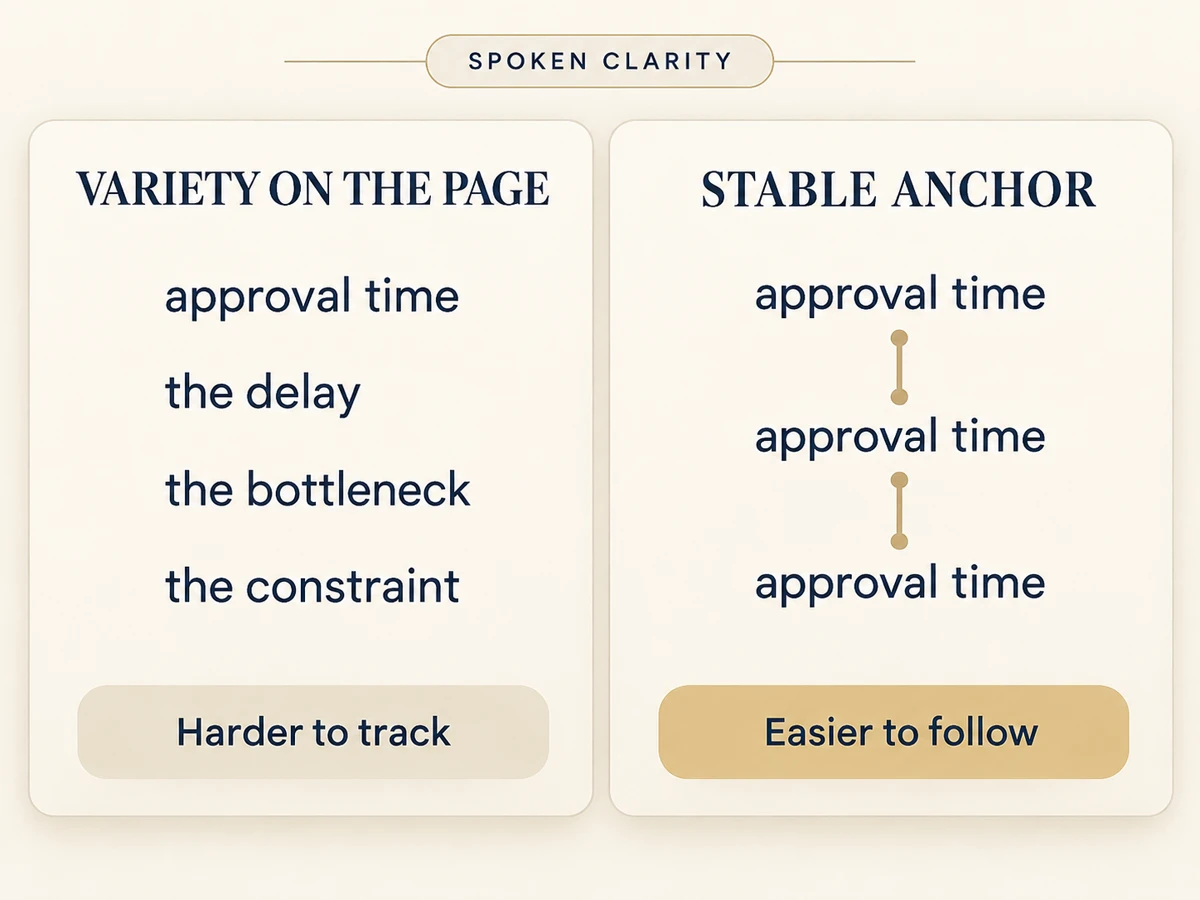
The main issue is approval time. This delay holds up the launch. That bottleneck affects the whole schedule. The constraint is what we should address first.
The language is varied.
It is also asking the listener to decide whether approval time, delay, bottleneck, and constraint are four related descriptions or four separate problems.
Now keep the important term stable:
The main issue is approval time. Approval time is holding up the launch. If we reduce approval time first, the rest of the schedule becomes easier to manage.
That is not lazy language.
The repeated phrase makes the logic visible:
approval time → launch delay → first priority
You can still edit the sentence for rhythm. You do not need to hide the core term in a synonym cupboard.
The same principle applies to research presentations.
Suppose your central finding is about measurement error.
Instead of moving through several near-synonyms:
The study found a problem with measurement error. This limitation affects the reliability of the result. That issue should be addressed in future work.
Try:
The study found measurement error in the data. That measurement error affects how confidently we can interpret the result. Future work should reduce the measurement error before we compare the groups.
The example is illustrative, not a claim about a real study. Its job is to show the listening pattern: name the anchor, connect the consequence to the anchor, then return to the anchor when you describe the next step.
Four moments when repetition helps
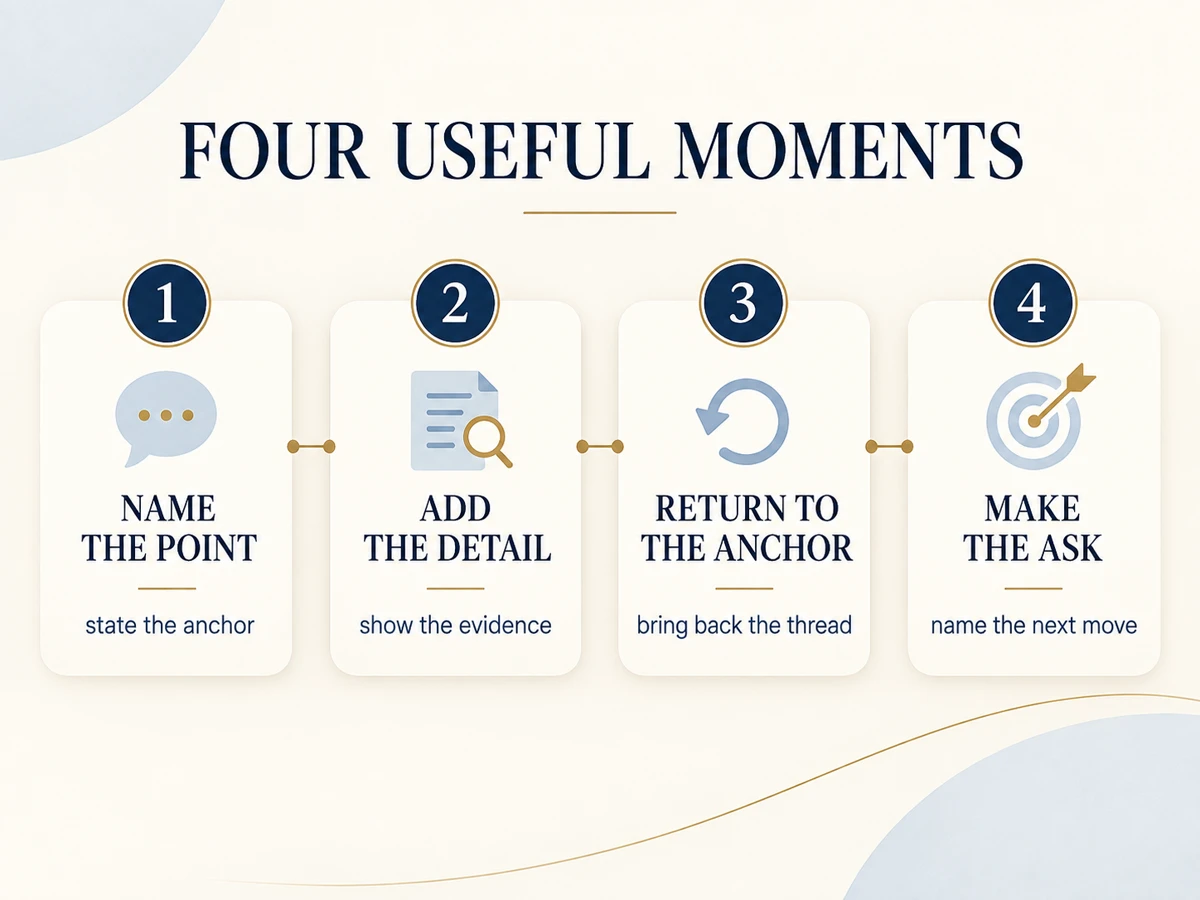
You do not need to repeat key words everywhere. These four moments usually give repetition a real job.
1. When you name the main point
State the point plainly, then use the same word when you explain why it matters.
Our main problem is handoff time. Handoff time is where the customer waits. So we recommend fixing handoff time before adding another feature.
The audience does not have to guess which part of the sentence is the headline.
2. When you move from one section to the next
A transition can repeat the previous anchor while opening the next question.
That is the cost of the current process. Now let us look at the cause of that cost.
Or:
We have seen the effect on delivery time. Next, I will show where that delivery time is being lost.
The repeated term creates a small bridge. The audience can feel that the talk is moving forward, not starting over.
3. When you return after detail
Details are useful. They can also make the audience lose the main thread.
After a chart, method explanation, or technical detour, bring back the anchor word.
The important point is still approval time. The technical change matters because it shortens approval time.
That sentence is doing a reset. It tells the audience which detail deserves to survive.
4. When you make the final ask
If the presentation has one recommendation, repeat the term that names it in the closing.
We have looked at the cause, the trade-off, and the implementation path. The decision today is to reduce approval time by testing the smaller review step first.
The audience has heard the phrase before. The closing gives it a final job.
Repeat the term, not the whole sentence
Useful repetition is usually small.
Repeat:
- the central problem
- the proposed action
- the audience decision
- the word that connects the evidence to the recommendation
Do not repeat a full paragraph because the paragraph was difficult to edit.
Here is the difference.
Too much:
We need to improve the handoff process. The handoff process is important because the handoff process affects the customer experience, and improving the handoff process will help us improve the customer experience.
More useful:
The handoff process is slowing the customer down. Fixing the handoff process is our first priority.
The anchor appears twice, and each appearance has a different job:
- identify the problem
- state the priority
That is enough. The sentence does not need to keep introducing itself.
When repetition makes the presentation worse
Repetition is not automatically clarity. Check the job each repeated word is doing.
It is probably not helping when:
- the repeated word is vague, such as thing, issue, or area
- you are repeating a sentence because you have not chosen the main point
- the same phrase appears several times without adding a new relationship
- the word is technically correct but no longer matches what you mean
- the repetition sounds like filler rather than a signpost
Compare:
We need to improve the process because the process has process-related problems.
The word repeats, but the idea does not move.
The fix is not to find a more impressive synonym for process. The fix is to say what the problem is.
We need to shorten the approval process because customers wait too long for a decision.
Now the repeated term has a clearer job, and the audience knows what is changing.
A five-minute repetition pass
Try this on one paragraph or one section of your presentation.
1. Write the point in plain language
What should the audience remember from this section?
Use one concrete noun or short phrase if you can.
2. Circle the anchor word
Look at your opening sentence, explanation, evidence, and transition. Which word names the idea that everything else supports?
If you have five possible anchor words, the section may be carrying too many points.
3. Check your synonyms
Have you replaced the anchor with challenge, opportunity, constraint, issue, or another broad substitute simply to avoid repeating it?
Put the original word back in at least once. See whether the logic becomes easier to hear.
4. Add one deliberate return
Repeat the anchor after the evidence or detail.
Try:
The data explains the pattern. The pattern matters because it changes our recommendation.
5. Say it aloud once
If the repeated word sounds clear, keep it.
If it sounds forced, ask whether the word is really the right anchor or whether the sentence needs a better verb.
The goal is not to make the audience notice your editing technique.
The goal is for them to stay with the idea.
Speaking is not an essay with fewer pages
Report writing often rewards compression and variation.
Presentation language has to reveal the relationship between ideas while the audience is hearing them.
That sometimes means repeating a key word that would look slightly inelegant on a page.
Good.
The audience is not grading the paragraph for literary variety.
They are trying to understand what matters, why it matters, and what happens next.
Give them a few stable words to help them do that.
This is the fourth fix in the series:
- turn abstract nouns back into actions
- unpack dense noun stacks
- make the actor obvious
- repeat key words when clarity matters
The pattern is simple: make the relationships easier to hear.
Your expertise can be complicated.
Your language does not need to make the audience rebuild the argument from spare parts.
Next in the series
Part 5: Build Recovery Points Into Spoken Language
Even a clear presentation can lose people for a moment. The final article in the series will look at how to give listeners a way back in when they miss a sentence, a term, or a turn in the argument.
Make Your Presentation English Easier to Follow
Previous: Part 3 — Make the Actor Obvious
Current: Part 4 — Repeat Key Words When Clarity Matters
Next: Part 5 — Build Recovery Points Into Spoken Language (upcoming)
Not sure which language problem is making your presentation difficult to follow?
If you are not sure whether the friction is in the wording, structure, slides, or delivery, start with the material you already have. Send a deck, script, outline, or short practice video for a Free Presentation Diagnostic. You will get focused feedback on what is blocking clarity and a recommended next step.