Make Your Presentation English Easier to Follow — Part 3 of 5
This article is part of a five-part series on making spoken English easier for an international audience to follow.
- Turn Abstract Nouns Back Into Actions
- Unpack Dense Noun Stacks
- Make the Actor Obvious
- Repeat Key Words When Clarity Matters
- Build Recovery Points Into Spoken Language — upcoming
A strange thing happens in business presentations.
Decisions get made.
Changes get implemented.
Problems get addressed.
New systems get introduced.
And somehow, nobody does any of it.
The sentence tells us that something happened, but the person, team, customer, company, or regulator responsible has quietly vanished.
Sometimes that is fine in a report.
When you are speaking, it can make a perfectly grammatical sentence surprisingly hard to follow.
The fix is simple:
When the actor matters, tell us who it is.
This is not an argument against passive voice. Passive voice is useful.
The problem starts when hiding the actor forces your audience to guess.
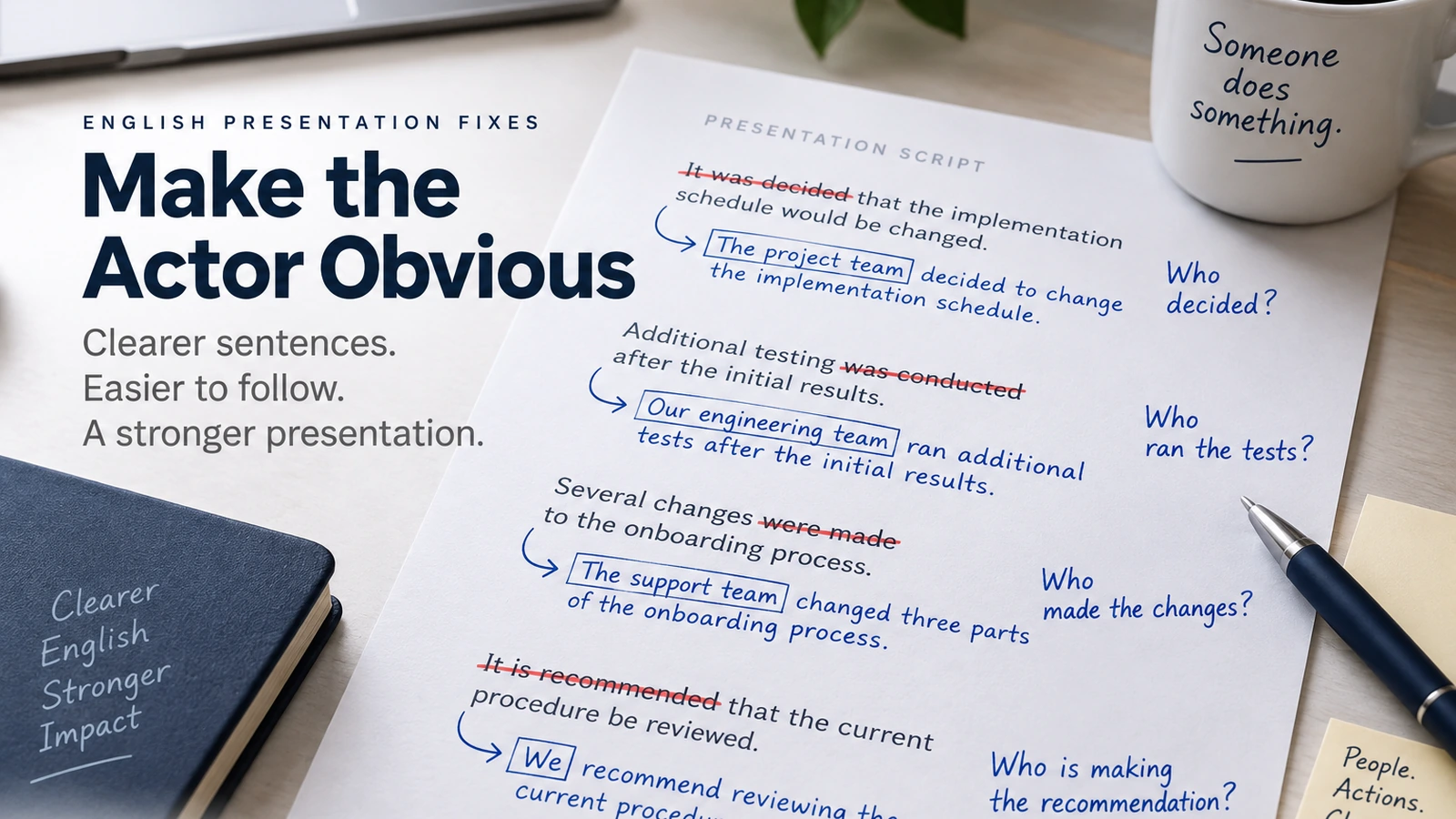
Who decided?
Consider this:
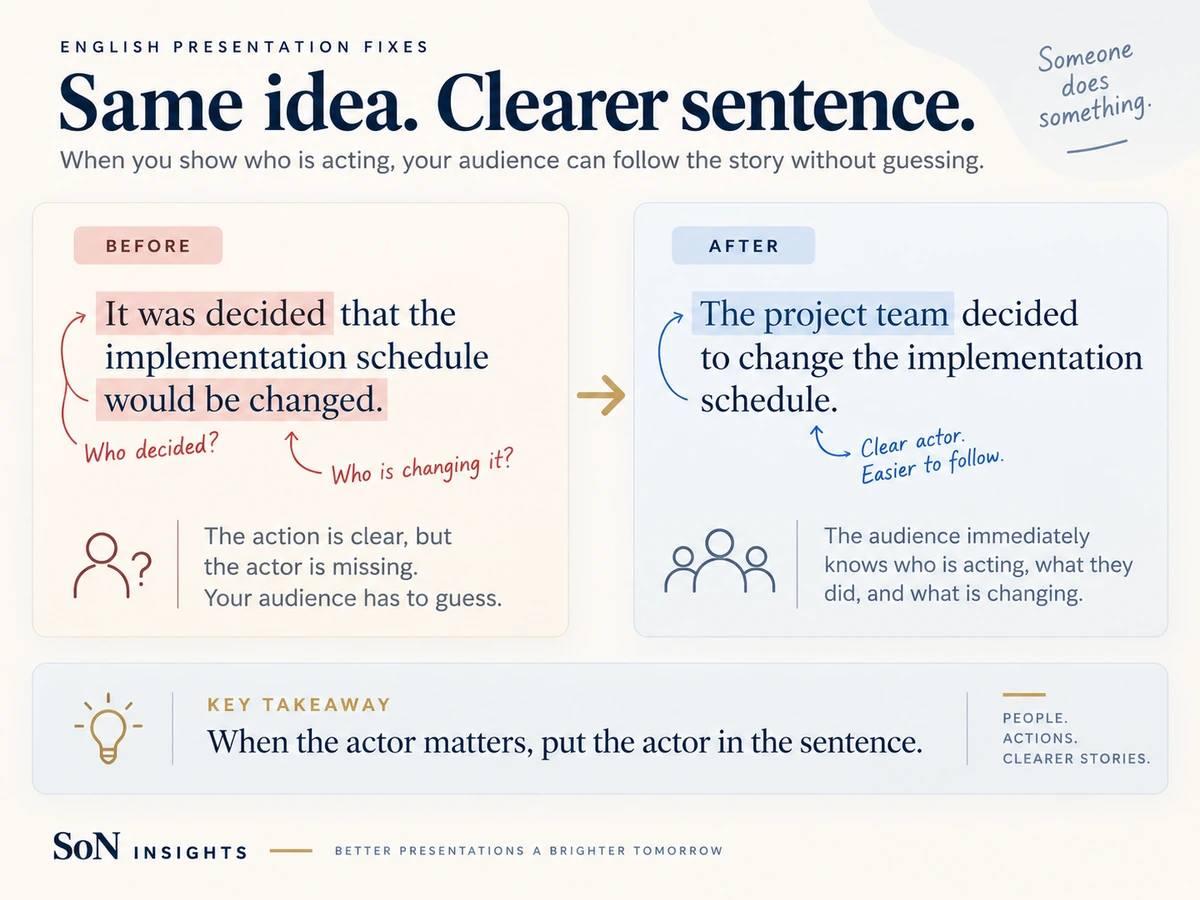
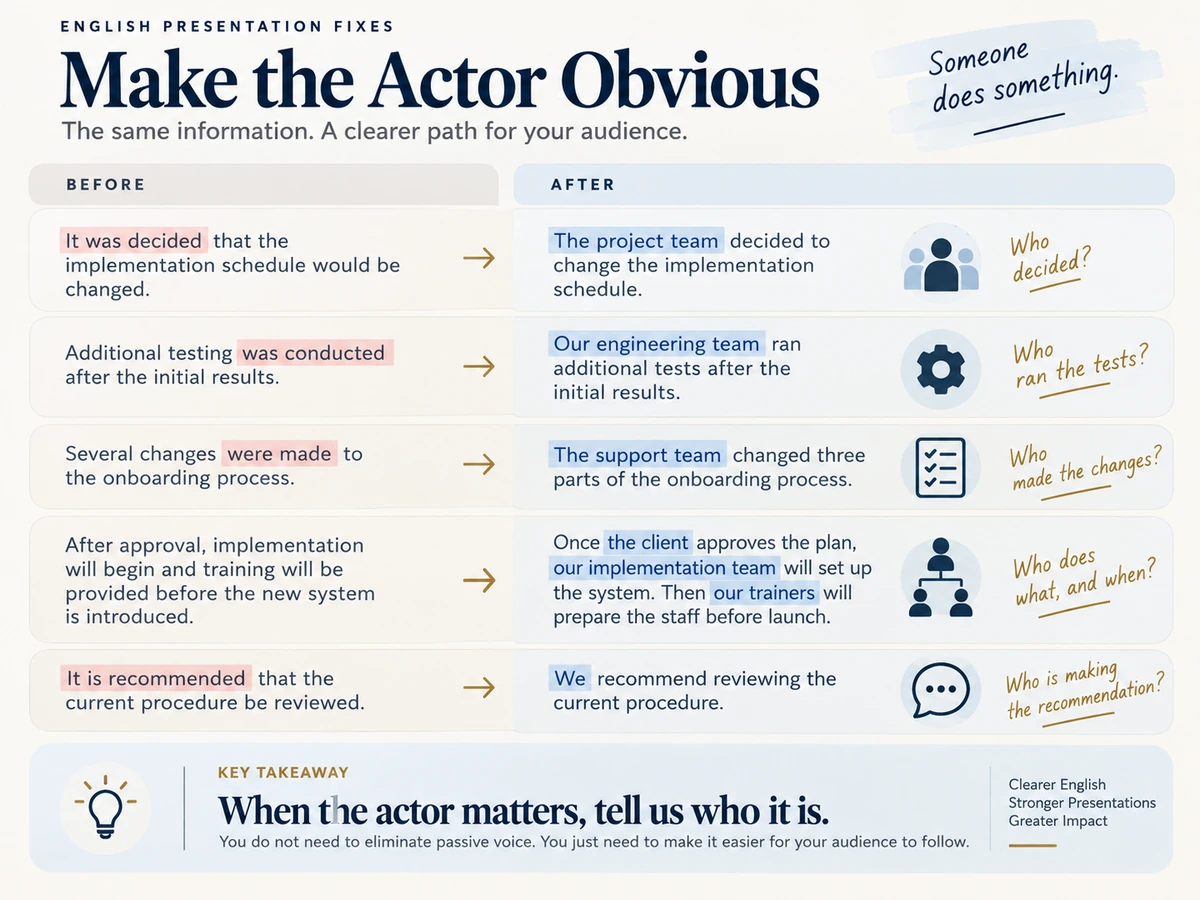
It was decided that the implementation schedule would be changed.
Perfectly respectable business English.
Also: who decided?
The project team?
Management?
The customer?
Some mysterious committee nobody is willing to name?
Now compare it with:
The project team decided to change the implementation schedule.
Immediately, we know:
who: the project team
did what: decided
what changed: the implementation schedule
That is much easier to hear.
And that matters because your audience cannot reread you.
Your listeners do not get a rewind button
When we read, we can stop.
We can look back at the previous sentence, figure out what a pronoun refers to, or untangle who did what.
A listener has a much worse deal.
Your sentence arrives, hangs around for a second, then disappears.
If the listener has to think:
Wait… who changed it?
you may already be halfway through the next point.
For someone processing the presentation in a second or third language, that extra work can matter even more.
This is why spoken English often needs to be a little more explicit than written English.
Not dumbed down.
Just easier to process the first time.
Watch for sentences where things just… happen
These are worth checking in your script:
It was decided that…
It was found that…
Changes will be made…
Improvements were implemented…
A new system was introduced…
Additional testing was conducted…
The issue will be addressed…
There is nothing automatically wrong with any of them.
Just ask:
Would knowing who did this help my audience understand the point?
If yes, put the actor back in.
Instead of:
Additional testing was conducted after the initial results.
Try:
Our engineering team ran additional tests after the initial results.
Instead of:
Several changes were made to the onboarding process.
Try:
The support team changed three parts of the onboarding process.
Instead of:
It was decided that the pilot should continue.
Try:
The client decided to continue the pilot.
No fancy vocabulary.
No grammar gymnastics.
We just stopped making the listener hunt for the person doing the action.
This matters even more when responsibility matters
Presentations constantly answer questions about ownership.
Who approves the plan?
Who changes the process?
Who pays?
Who uses the system?
Who has to do something next?
If those people keep disappearing from the language, your presentation starts to feel vague even when your actual thinking is solid.
Take this:
After approval, implementation will begin and training will be provided before the new system is introduced.
There is plenty happening.
Who is doing any of it?
Now:
Once the client approves the plan, our implementation team will set up the system. Then our trainers will prepare the staff before launch.
Slightly longer.
Much clearer.
Now we can see the sequence:
client → approves
implementation team → sets up
trainers → prepare staff
That is not just a grammar improvement.
It makes the logic visible.
Recommendations need an owner too
Formal business English has a habit of making recommendations sound as though they appeared spontaneously in the meeting room.
It is recommended that the current procedure be reviewed.
Recommended by whom?
If it is your recommendation:
We recommend reviewing the current procedure.
If the research leads you there:
Our results suggest that the current procedure should be reviewed.
If another group owns the recommendation:
The safety team recommends reviewing the current procedure.
Now the audience knows where the recommendation came from.
That makes the sentence clearer, but it also makes the claim more credible.
And then there is “we”
Once people notice this problem, they sometimes fix everything with we.
We developed the system.
We tested the system.
We reviewed the results.
We changed the process.
We approved the rollout.
Fine.
Except… who exactly is we?
Your research team?
Your department?
Your company?
You and the client?
Everyone involved except Gary?
“We” works beautifully once the group is clear.
If it is not clear yet, name the group.
Instead of:
We reviewed the problem with the customer.
Try:
Our support team reviewed the problem with the customer.
After that, once everyone knows who you mean, we can do its job.
Clarity first. Shortcuts second.
Try this on one paragraph
Take one paragraph from your presentation and underline every action.
For example:
The initial data was reviewed and several problems were identified. Changes were then made to the process. After two weeks, another review was conducted and an improvement was observed.
Now interrogate it.
Who reviewed the data?
Who found the problems?
Who changed the process?
Who checked again?
You probably know.
Your audience may not.
Here is a clearer version:
Our operations team reviewed the initial data and found three problems. They changed the process and checked the results again two weeks later. The second review showed an improvement.
Notice what we did not add.
More sophisticated English.
In fact, the language got simpler.
But the story got easier to follow because someone is actually doing something.
Do not declare war on passive voice
“Never use passive voice” is one of those writing rules that desperately needs a quiet retirement.
Passive voice can be exactly right.
Sometimes the action matters more than the actor:
The samples were stored at -20°C.
Sometimes the actor is unknown:
The account was accessed overnight.
Sometimes everybody already knows who is responsible:
The final report will be published on Friday.
No problem.
So do not ask:
Is this passive voice?
Ask:
Does hiding the actor make this harder to understand?
That is the useful test.
Five things to check before you present
Look through your script for:
- [ ] Actions where the audience may not know who performed them
- [ ] Decisions with no obvious decision-maker
- [ ] Recommendations where the source is unclear
- [ ] Long sequences where several things “are done” without clear ownership
- [ ] Uses of “we” where the audience may not know who “we” actually means
You do not need to rewrite every passive sentence.
Fix the ones that make your audience guess.
Make the logic visible
This whole series is really about reducing unnecessary work for the listener.
In Part 1, we turned abstract nouns back into actions.
In Part 2, we unpacked dense noun stacks.
Now we are connecting those actions to the people who perform them.
At the center of all three fixes is an almost embarrassingly simple structure:
Someone does something.
Good.
Save the complexity for the idea that actually deserves it.
Your expertise may be complicated.
Your sentences do not need to make it worse.
Next in the series
Part 4: Repeat Key Words When Clarity Matters
Writers are often taught to avoid repetition.
Speakers sometimes need to ignore that advice.
In Part 4, we will look at why repeating an important word can make a presentation easier to follow, especially when swapping in synonyms creates more confusion than variety.
Make Your Presentation English Easier to Follow
Previous: Part 2 — Unpack Dense Noun Stacks
Current: Part 3 — Make the Actor Obvious
Next: Part 4 — Repeat Key Words When Clarity Matters
Not sure where your presentation is getting difficult to follow?
If you are not sure what is actually weakening your presentation, start with the Free Presentation Diagnostic.
Send a deck, script, or short practice video for practical expert feedback and a recommended next step.