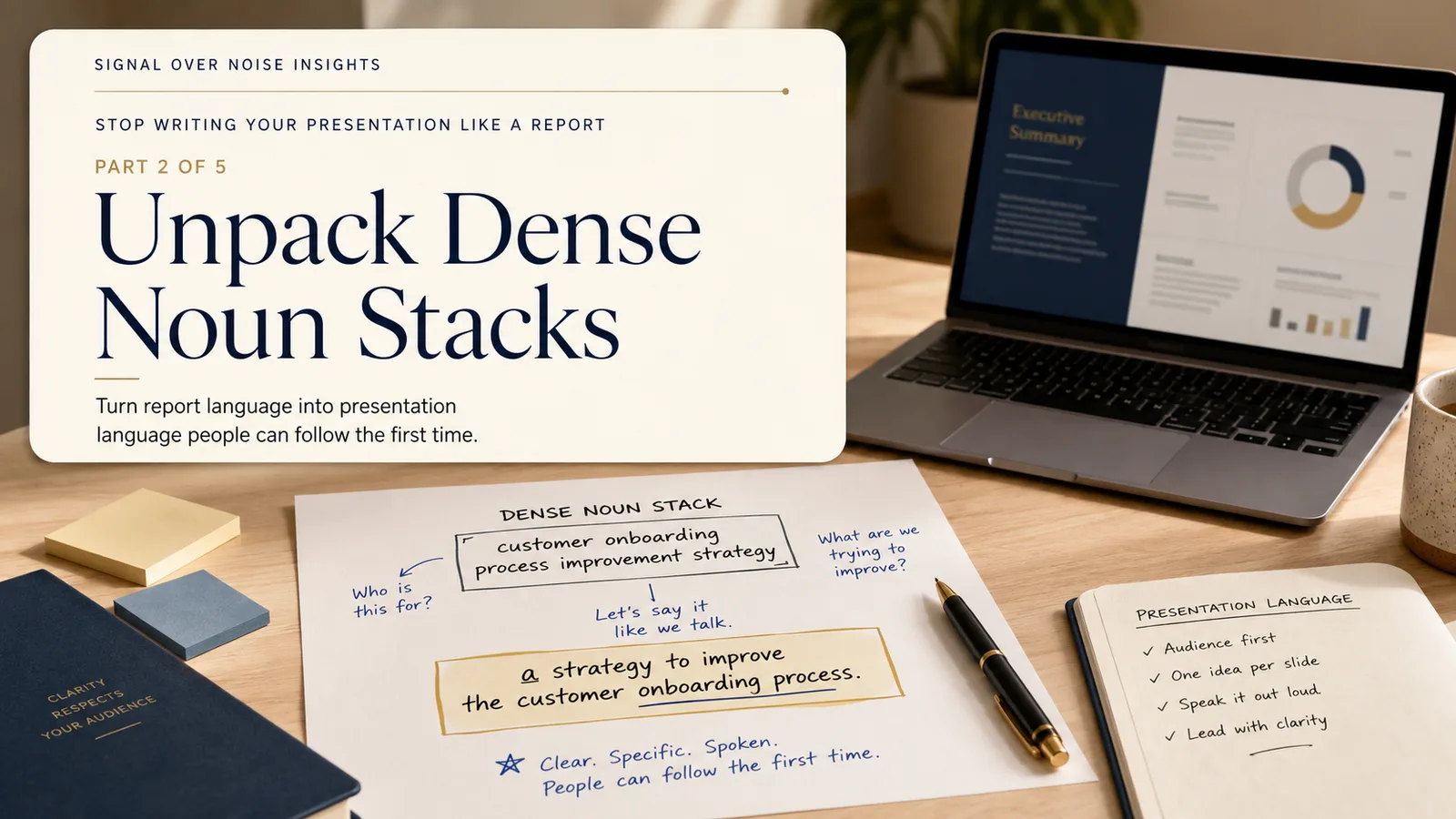
Part 2 of 5 in the series: Stop Writing Your Presentation Like a Report
In Part 1: Turn Abstract Nouns Back Into Actions, we looked at abstract nouns that hide the action.
Implementation became implement.
Evaluation became evaluate.
Improvement became improve.
That gets the action moving again.
But sometimes the problem is not one abstract noun.
It is five nouns standing in a row pretending to be a sentence.
Consider this:
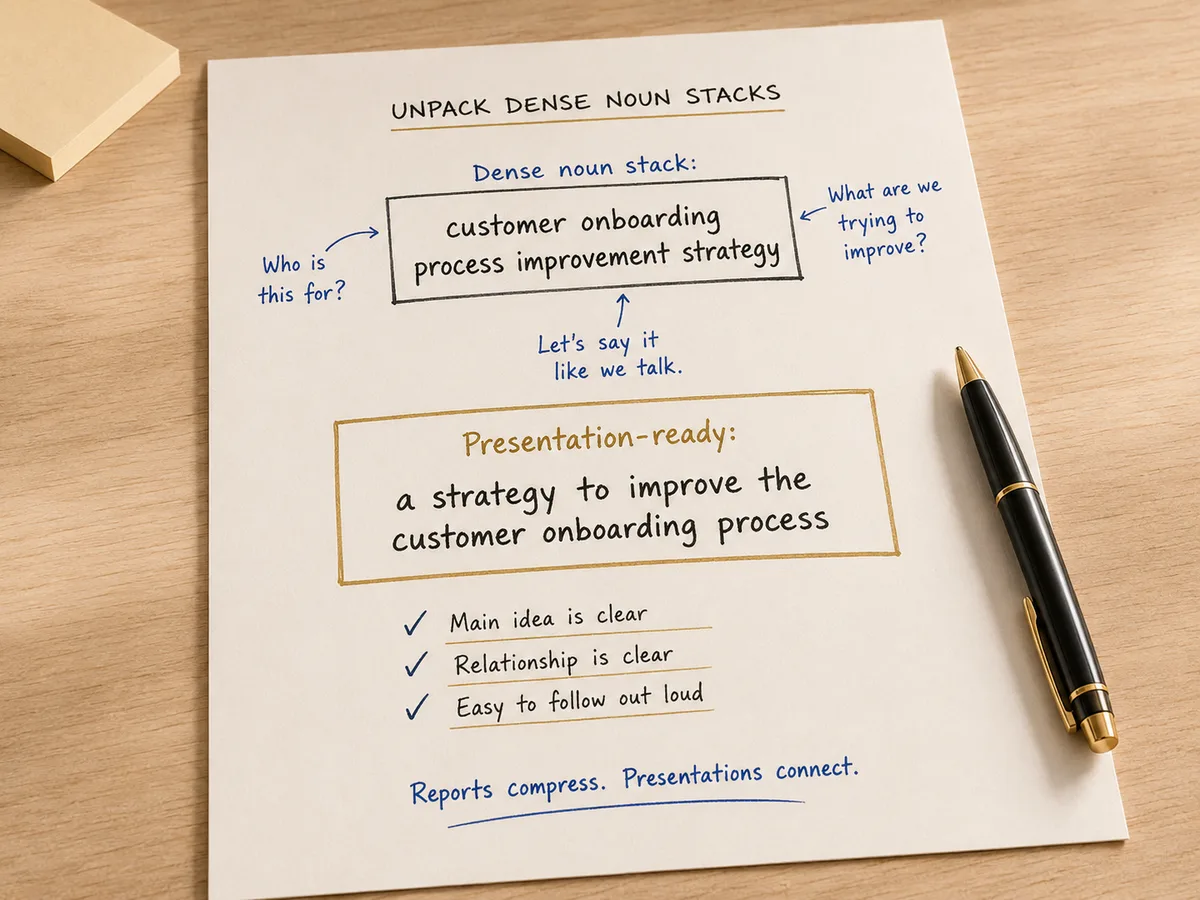
customer onboarding process improvement strategy
If you work with that project every day, you probably know exactly what it means.
Your audience has a less enjoyable job.
Are we improving the onboarding process? Is this a strategy for improving customer onboarding? Are we talking about how to improve the strategy?
Written language gives the reader time to stop and work it out.
A presentation does not.
Short answer: When several nouns are packed together, unpack the relationships between them. Add the missing verbs and connecting words so the audience understands the idea as they hear it, instead of reverse-engineering it afterward.
What is a noun stack?
A noun stack is a string of nouns used together to describe one idea.
Business, academic, technical, and government writing is full of them:
customer account activation delay reduction plan
employee performance evaluation system update
international market expansion proposal review
equipment failure risk monitoring procedure
None of these is necessarily grammatically wrong.
That is not the test.
The real question is whether someone can understand the relationship between all those nouns the first time they hear them.
That is where presentations get into trouble.
Why noun stacks work better on paper
Reports can get away with compact labels.
Specialists may already know the terminology. The same phrase may appear repeatedly throughout the document. And most importantly, readers can stop, reread, look back at the previous paragraph, or stare at the phrase until it gives up its secrets.
Listeners cannot.
When you say:
We completed the overseas partner onboarding support process review.
the audience has to hold several nouns in working memory while figuring out what modifies what.
By the time they solve the puzzle, you are already halfway through the next sentence.
Your audience should be following your argument, not performing grammar archaeology.
Find the real relationship
When you see three, four, or five nouns packed together, do not immediately start deleting words.
First ask what the nouns are actually doing.
Usually the phrase is hiding a relationship such as:
- for
- of
- about
- during
- to
- from
- by
- how
- why
Take this:
customer account activation delay reduction plan
What do we really mean?
A plan to reduce delays when we activate customer accounts.
The new version is longer.
It is also much easier to understand.
That is an important trade-off in presentation language:
Shorter on the page is not always clearer in the room.
Put the action back in
Often the fastest fix is to put a verb into the phrase.
Report-style
overseas partner onboarding support process review
Presentation-ready
We reviewed how we support overseas partners during onboarding.
Now we know:
- who acted: we
- what they did: reviewed
- what they reviewed: how we support overseas partners
- when: during onboarding
Nothing complicated happened.
We simply stopped asking four nouns to do the work of an entire sentence.
Here are a few more illustrative examples:
| Dense report language | Easier to hear |
|---|---|
| training effectiveness evaluation result summary | Here is what the evaluation showed about the training. |
| system maintenance failure risk monitoring procedure | We monitor the system during maintenance so we can catch failure risks early. |
| customer feedback response process improvement plan | We have a plan to improve how we respond to customer feedback. |
| regional sales performance review meeting | We are meeting to review sales performance across the region. |
| product launch communication strategy implementation | We are putting the product-launch communication strategy into practice. |
The rewritten versions are not always shorter.
They are easier to process.
For a presentation, that is the better target.
Your slide titles can have the same problem
Noun stacks do not stop at the script.
They love slide titles.
You get things like:
Q3 Customer Retention Improvement Strategy Review
It certainly sounds official.
It also tells the audience almost nothing.
What happened to retention? What did the review find? What are we supposed to notice?
A slide title should usually do more than name the folder the information came from.
Try this instead:
Why customer retention fell in Q3, and what we should change
Now the audience knows what they are looking for.
Much better.
Keep the technical language you actually need
Clear presentation language does not mean replacing every technical term with kindergarten English.
If your audience needs the term, keep it.
A specialist audience may absolutely need language such as:
- regression analysis
- supply chain resilience
- machine learning model validation
- customer acquisition cost
- failure mode analysis
The technical vocabulary itself is not the problem.
The problem starts when necessary technical terms get buried inside a pile of other nouns.
For example:
machine learning model validation performance assessment
can become:
We assessed how well the machine learning model performed during validation.
Same technical idea.
Far less decoding.
Keep the important terminology. Unpack the sentence around it.
Use the “one hearing” test
Here is the quickest way to catch noun stacks that need work.
Read the sentence aloud once.
Not slowly.
Not in your special presentation voice.
At the pace you would actually speak.
Then ask:
Could someone who does not already know this project understand how these ideas relate after hearing them once?
If your answer is:
“Probably, once I explain it…”
Great.
Explain it now.
That is the presentation.
A four-step fix
When you find a dense noun stack:
1. Find the main thing
What is the phrase actually about?
A plan? A review? A process? A result? A problem?
2. Work out what the other nouns are doing
Are they telling you:
- what it is for?
- who it affects?
- when it happens?
- what caused it?
- what was evaluated?
- what needs to change?
3. Add the relationship
Use a verb or connecting word.
to, for, about, during, because, how, when
Do not be afraid of these words.
They are doing useful work.
4. Say it aloud
If it still sounds like a committee named the sentence, try again.
Quick noun-stack check
Before your next presentation, scan your script and slides for phrases containing three or more nouns in a row.
Ask:
- [ ] Can I immediately tell which noun is the main idea?
- [ ] Is the relationship between the nouns obvious?
- [ ] Would a verb make the action clearer?
- [ ] Would
for,of,during,to, orhowhelp? - [ ] Does the audience actually need all these technical terms?
- [ ] Can someone understand the phrase after hearing it once?
- [ ] Is the slide title communicating a message, or merely naming a topic?
You do not have to eliminate every noun stack.
Some are familiar enough to work perfectly well.
customer service team is not exactly bringing civilization to its knees.
The goal is to notice when a neat written label becomes a listening problem.
Reports compress. Presentations connect.
Good reports can pack a lot of meaning into a small amount of text.
Presentations have a different job.
They need to reveal the relationships between ideas while the audience is listening.
Sometimes that means adding a word.
Sometimes adding a verb.
Sometimes turning a six-word label into an actual sentence.
The goal is not to make the English simpler just for the sake of simplicity.
It is to make the thinking easier to follow.
Series: Stop Writing Your Presentation Like a Report
- Turn Abstract Nouns Back Into Actions — Part 1
- Unpack Dense Noun Stacks — Part 2, you are here
- Make the Actor Obvious — Part 3
- Repeat Key Words When Clarity Matters — Part 4
- Build Recovery Points Into Spoken Language — Part 5, upcoming
If your presentation started life as a report, proposal, research paper, or AI-generated document and you are not sure which parts will be difficult to follow out loud, send the actual material.
The Free Presentation Diagnostic gives you focused feedback on what needs attention first, so you can work on the part that is actually creating friction instead of rewriting everything.