STOP WRITING YOUR PRESENTATION LIKE A REPORT
Part 5 of 5
Build Recovery Points Into Spoken Language
A reader can go back.
That simple fact changes a lot.
If a sentence in a report is difficult, the reader can read it again. If they forget what Point 2 was, they can glance upward. If a paragraph gets dense, they can stop for a second and sort it out.
Your presentation audience can't do that.
You say the sentence.
It's gone.
And you keep talking.
That means spoken language needs something reports often don't: places where the audience can find the thread again.
I call them recovery points.
Your audience will lose the thread sometimes
That's normal.
People look at your slides. They take notes. They think about something you just said. Someone enters the room. A phone vibrates. Their brain wanders off for five seconds because apparently brains have other plans.
Then they come back.
Here's the question:
Can they figure out where they are?
Report-style writing often assumes continuous attention because the reader controls the pace.
A presentation can't.
So good spoken language gives the audience occasional landmarks:
- “There are three things we looked at.”
- “Here's the important part.”
- “So what does this mean?”
- “There's one result I want you to remember.”
- “We've looked at the problem. Now let's look at the solution.”
These aren't empty transition phrases.
Used well, they tell the listener where they are, what matters, and what's coming next.

Example 1: A recommendation
Report
The proposal is based on three primary considerations: implementation cost, operational feasibility, and long-term scalability, with the latter representing the most significant factor in the final recommendation.
Perfectly reasonable on the page.
Spoken aloud, though, you're asking the audience to remember three items, hear “the latter,” remember which item came last, and then connect it to your recommendation.
That's a lot of mental paperwork for one sentence.
Better
The proposal is based on three things: implementation cost, operational feasibility, and long-term scalability. Scalability is the most important factor in our final recommendation.
Much easier.
We repeat scalability instead of making the listener retrieve it from the list.
Now let's make it work as speech.
Presentation-ready
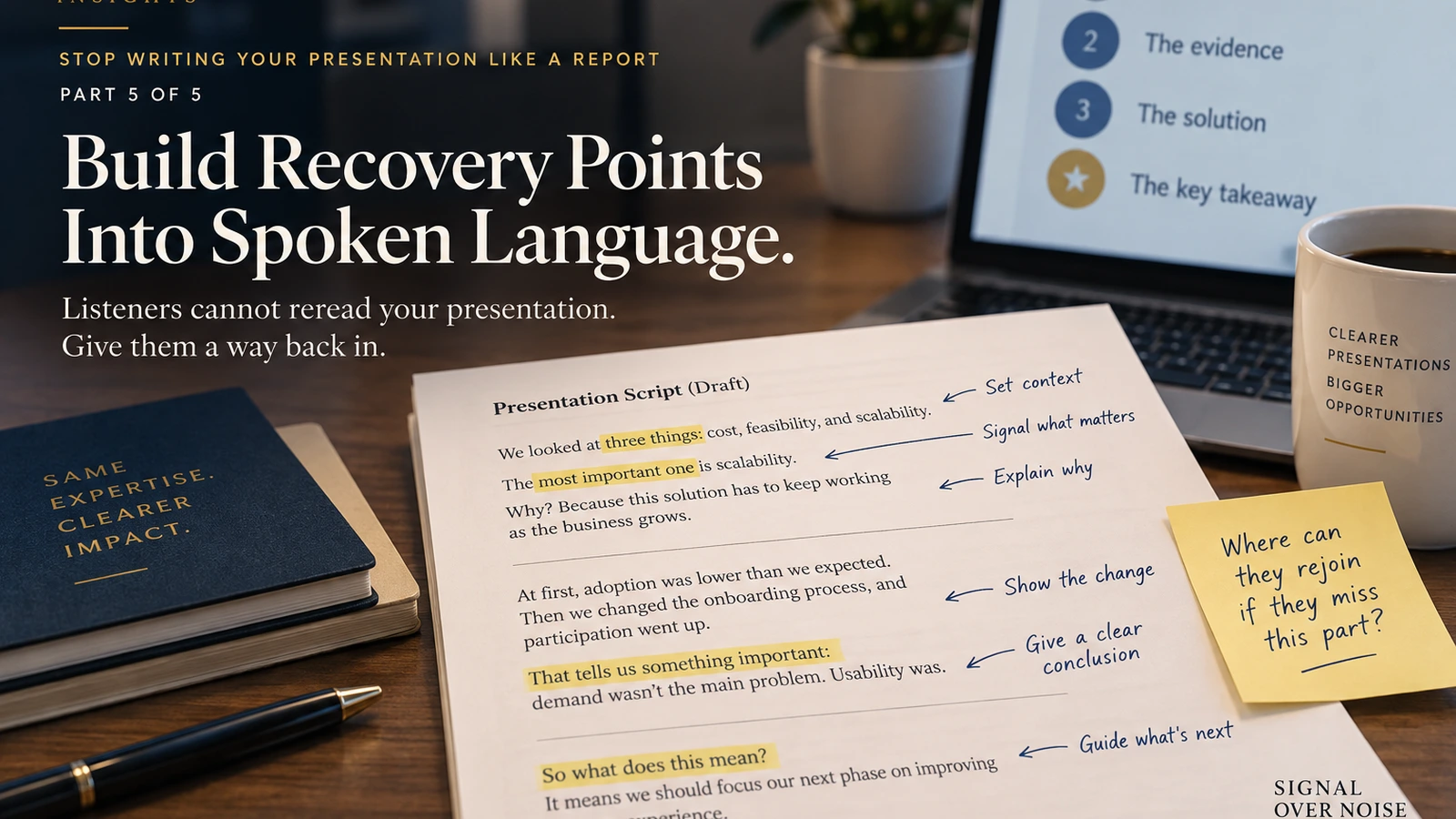
We looked at three things: cost, feasibility, and scalability.
The most important one is scalability.
Why? Because this solution has to keep working as the business grows.
Now the audience gets three clear checkpoints:
Here are the three things.
Here is the important one.
Here is why it matters.
Miss part of the list? The next sentence gives you a way back in.
That's a recovery point.
Recovery points aren't just transitions
You may have learned this as signposting:
“First, I will discuss…”
“Next, I will explain…”
“Finally, I will conclude…”
Technically, yes. That's structure.
It can also make you sound like you're reading the agenda at the Annual Committee Meeting for Committees.
Recovery points do something more useful.
They help the audience follow the logic.
A good one might tell them:
- the evidence is finished
- the conclusion is coming
- this is the important result
- we're changing direction
- this connects to something they heard earlier
You're not narrating your table of contents.
You're keeping people oriented.
Example 2: A project update
Report
Although initial adoption was lower than anticipated, subsequent improvements to the onboarding process resulted in increased participation, indicating that usability rather than demand represented the primary barrier.
Again, perfectly respectable report language.
But listen to how much arrives at once:
- adoption was low
- onboarding changed
- participation increased
- usability was a problem
- demand wasn't
Miss one connection and the conclusion gets fuzzy.
Better
Initial adoption was lower than expected. After we improved onboarding, participation increased. This suggests that usability, rather than demand, was the main problem.
Much easier.
Presentation-ready
At first, adoption was lower than we expected.
Then we changed the onboarding process, and participation went up.
That tells us something important: demand wasn't the main problem. Usability was.
That little phrase does real work:
That tells us something important.
It warns the audience:
The evidence is finished. The conclusion is coming.
It also tells them to pay attention.
One small phrase. Two jobs.
Example 3: Research findings
Report
Analysis of the participant interviews revealed three recurring concerns relating to preparation time, task complexity, and uncertainty regarding expectations, with uncertainty emerging as the most consistent theme across groups.
A reader can stop after the list and look at it again.
A listener gets one shot.
Better
Our analysis found three recurring concerns: preparation time, task complexity, and uncertainty about expectations. Uncertainty was the most consistent concern across the groups.
Clearer.
Now let's tell the audience what to do with that information.
Presentation-ready
We heard three concerns again and again: preparation time, task complexity, and uncertainty about expectations.
But one came up more than the others: uncertainty.
People weren't always sure what was expected of them.
That middle sentence gives the audience somewhere to land.
Don't treat all three items as equally important.
Remember this one.
That's part of your job as the presenter.
Tell people what deserves attention
A report can put information on a page and let the reader decide where to look.
A presentation has an advantage:
you're there.
You can guide attention.
So phrases like these can be genuinely useful:
“Here's the important part.”
“This is where the result gets interesting.”
“There are two reasons.”
“The first problem is straightforward. The second is harder.”
“So what changed?”
“If you remember one number, make it this one.”
They don't add much information themselves.
They add structure to the information around them.
That's the point.
Try the five-second test
Take a section of your script.
Now imagine someone stops listening for five seconds.
Maybe they're studying the chart. Maybe they're writing something down. Maybe their brain has briefly left the building.
Then ask:
Where can they rejoin?
Look especially at places where you:
- explain several steps without summarizing
- present a list and immediately move on
- give several results with no indication of which matters most
- move from evidence to conclusion without marking the shift
- start a new idea without orienting the audience
- make the main point once and never return to it
If missing one sentence means they're lost for the next two minutes, you've got a problem.
Give them a way back in.
Don't turn into verbal GPS
There is, of course, a way to ruin this.
“Now let's move on…”
“Next, I would like to discuss…”
“Moving forward to our next point…”
Every. Single. Minute.
Please don't.
Recovery points work because they appear when the audience needs orientation.
The goal isn't constant signposting.
It's strategic orientation.
Give the audience enough help to know:
- where they are
- what matters
- how the ideas connect
- when evidence becomes a conclusion
- where you're going next
A report can assume the reader will go back.
A presentation should give the listener a way back in.
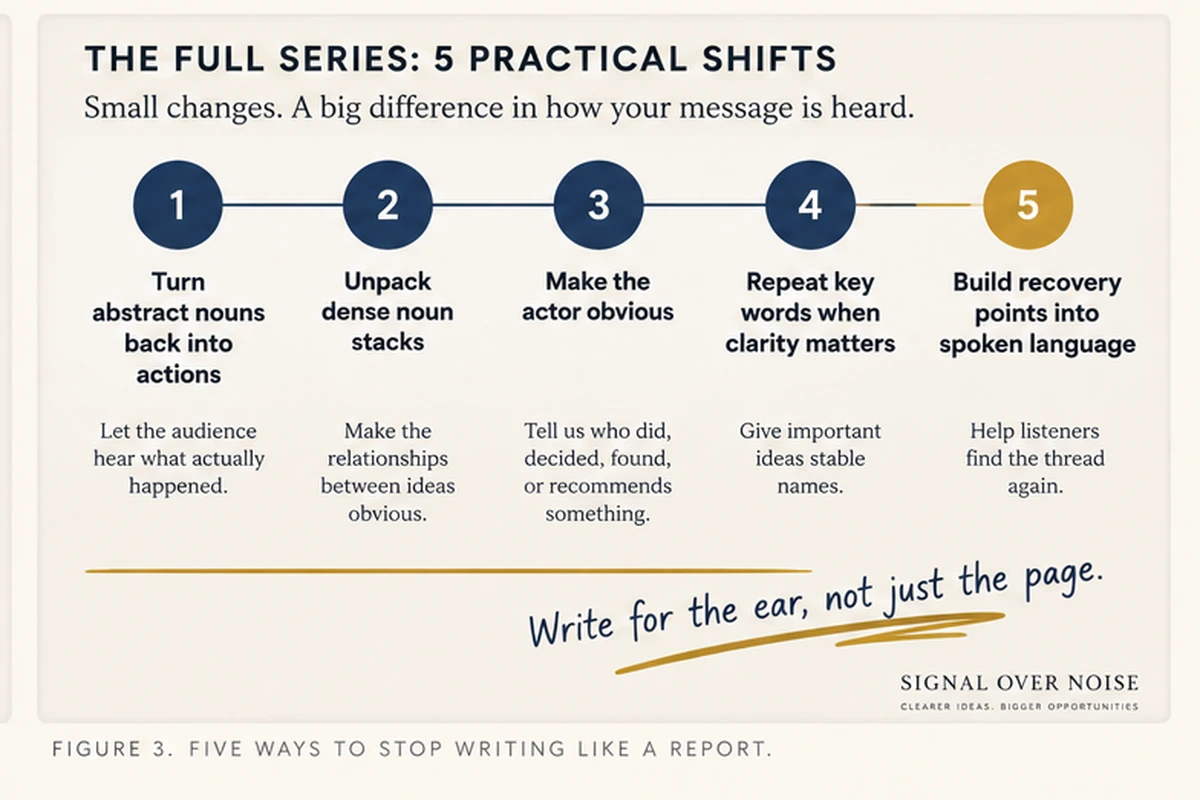
Five ways to stop writing your presentation like a report
This is the final article in the series.
Across the five parts, we've made five different changes.
1. Turn abstract nouns back into actions
Let the audience hear what actually happened.
2. Unpack dense noun stacks
Make the relationships between ideas obvious.
3. Make the actor obvious
Tell us who did, decided, found, or recommends something when that matters.
4. Repeat key words when clarity matters
Give important ideas stable names instead of constantly renaming them.
5. Build recovery points into spoken language
Help listeners find the thread again.
None of these is really about making your English “simpler.”
And they're definitely not instructions to make every presentation casual.
They all come from the same basic difference:
A reader can stop and reconstruct your meaning. A listener needs you to make the structure clear while you're speaking.
That's the shift.
Write for the ear, not just the page.
Try the full series test
Take one important paragraph from your presentation and ask:
- Are important actions hidden inside abstract nouns?
- Are several nouns packed together so tightly that the relationships are hard to hear?
- Is it obvious who is doing what?
- Do important ideas keep the same name?
- If someone loses the thread, is there somewhere they can rejoin?
You don't have to rewrite everything.
Find the sentence that makes your audience work hardest.
Start there.
Not sure where the real problem is?
Sometimes the script is the problem.
Sometimes the wording is only hiding a bigger issue with the message, structure, slides, or delivery.
The Free Presentation Diagnostic starts with the actual presentation material and helps identify what needs attention first.