You have rehearsed the presentation three times.
You have changed the transitions, moved two slides, and highlighted the sentence you keep forgetting. You may even have practiced it into a state of mild personal resentment.
But each run still feels different. The opening takes too long to explain. One slide needs a rescue speech. The ending is clear only after you add another two minutes of context.
At that point, more rehearsal may not be the answer.
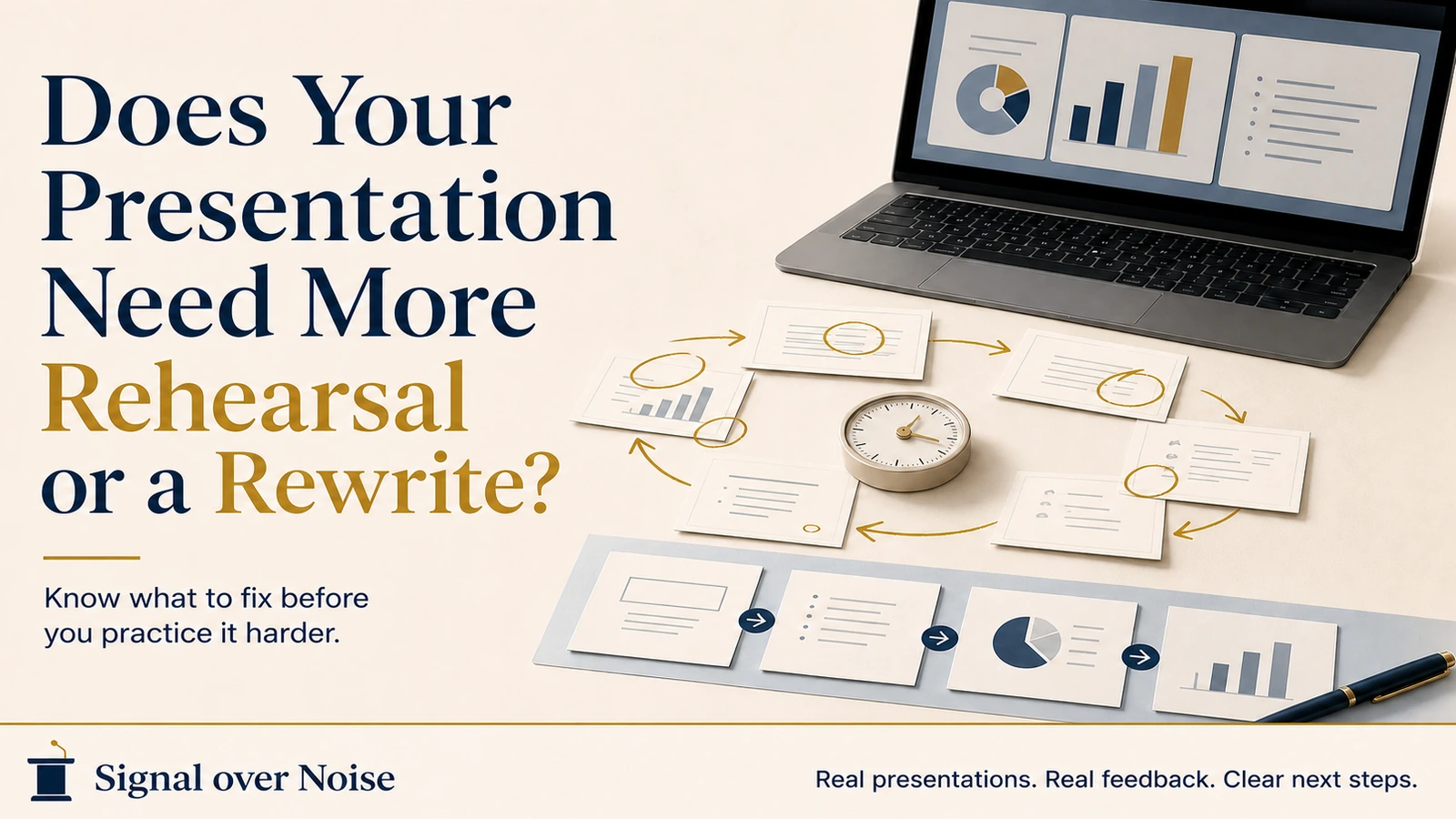
Short answer: Rehearse more when the message, structure, slides, and final ask are already clear. Revise first when you keep explaining around the deck, changing the story every time, or struggling to say the main point plainly.
Rehearsal matters. It helps you sound more natural, manage timing, recover when you lose a line, and make a good presentation feel like yours.
It cannot reliably solve a presentation that is unclear on the page.
The difference is not “content” versus “confidence”
People often describe the problem as confidence.
Sometimes it is. You know what you want to say, the slides support it, and you simply need more time saying it out loud. That is a rehearsal problem.
But sometimes “I need more confidence” means something else:
- you cannot tell which point should come first
- the slides need a long explanation before they make sense
- you keep changing the emphasis because there is no clear through-line
- you know the information, but not what the audience should do with it
That is not a character flaw. It is a signal that the material needs a clearer job before you ask yourself to perform it better.
| If this is happening | Start with | Why |
|---|---|---|
| The story, slide order, and final ask keep changing | A rewrite | Practice will only make an unstable route feel more familiar. |
| The material is clear, but you rush, freeze, or run long | Rehearsal | The presentation has a stable path; delivery needs repetitions. |
| You cannot tell which problem you have | A diagnostic review | Looking at the real deck, script, or practice clip is more useful than guessing from inside it. |
Five signs to revise before you rehearse again
1. You cannot state the point in one sentence
Try this before you open the deck:
“By the end of this presentation, I need the audience to understand that ___ and do ___.”
If that sentence turns into a paragraph, a list of topics, or “well, it depends,” start there. A rehearsal cannot create a single point on your behalf.
Your presentation may contain several useful ideas. The audience still needs to know which one is in charge.
2. Your opening needs too much verbal rescue
An opening can set context. It should not need to apologize for the first three slides.
If you repeatedly say things like “This will make more sense in a minute” or “Let me give you a bit of background first,” check whether the deck is withholding the point too long.
You may need a clearer opening that tells the audience:
- what this is about
- why it matters now
- what you recommend, need, or want them to consider
Context is useful. A long runway is not automatically useful just because you built it carefully.
3. You have to explain what the slide is supposed to mean
A slide does not need to contain the whole argument. But it should help the audience follow the argument you are making.
If a chart title says “Quarterly performance” while you say, “The important thing is that the regional mix changed and we need to adjust the plan,” the slide is making the audience do extra work.
The slide title could do more of the navigation:
| Instead of | Try a title that tells the point |
|---|---|
| Quarterly performance | Growth held, but the regional mix changed |
| Customer feedback | New users are blocked before the first useful action |
| Project update | We need a decision on scope before the deadline moves |
Those are illustrative examples, not magic sentences. The test is simple: can someone see the direction of the slide before you give the full explanation?
4. Each rehearsal produces a different story
Small improvements between runs are normal. Rewriting the logic of the presentation every time is different.
If Tuesday’s version starts with the market problem, Wednesday’s starts with product features, and Thursday’s starts with the team because it suddenly feels safer, you may not have a stable structure yet.
That does not mean every presentation needs a grand storytelling framework and a string quartet. It means the order needs to make sense to the people in the room.
Before another full rehearsal, write the presentation as five plain steps:
- Here is the situation.
- Here is the problem or opportunity.
- Here is what matters most.
- Here is the evidence or plan.
- Here is the decision or next step.
If that sequence feels artificial, incomplete, or hard to map to your slides, revise the structure first.
5. Your ending works only after one more explanation
An ending should not introduce a fresh puzzle.
If you reach the final slide and feel compelled to add, “What I really mean is…” the recommendation or ask may have arrived too late, or it may not be specific enough.
A useful closing makes three things easy to catch:
- the point
- the consequence
- the next move
For example: “The current approach will not support the launch timeline. I recommend we approve the smaller pilot this week, then review the result before expanding.”
That is more useful than ending with “Thank you” and hoping the audience can infer the decision from the atmosphere.
What a real rehearsal problem looks like
You probably do need more rehearsal when the material is clear but the delivery breaks down in predictable ways:
- you rush when the stakes rise
- you lose your place between sections
- your timing runs long even after the content is stable
- you read rather than speak to the room
- you answer questions well in conversation but freeze during the presentation
- the wording is clear on paper but awkward to say aloud
These are real delivery issues. They deserve practice, and practice will help.
The key distinction: you should be practicing a stable presentation, not using rehearsal to discover what the presentation is about.
A 15-minute test before your next rehearsal
You do not need a full rebuild to decide what needs attention. Take one representative slide and try this:
- State the slide’s point in one sentence without looking at it.
- Show the slide to someone or look at it cold after a short break.
- Ask: “What do you think this slide wants me to understand or decide?”
- Compare their answer with your intended point.
If the point survives, rehearse the explanation. If it does not, revise the slide title, order, or supporting information first.
Then repeat with your opening and ending. Those three moments usually reveal whether you need more repetitions or a clearer route through the material.
Do not practice the confusion into a smoother performance
There is no prize for becoming exceptionally fluent at explaining why the deck is confusing.
Get the message, structure, slides, and ask stable enough that rehearsal can do its proper job: helping you deliver the presentation with clarity and control.
If you are not sure whether the friction is in the deck, script, message, or delivery, start with the material you already have. Send a deck, script, outline, or short practice video for a Free Presentation Diagnostic. You will get focused feedback on what is blocking clarity and a recommended next step.