You can have strong English, clean slides, and a practiced script, and still lose an international audience.
Not because the audience is difficult.
Because international presentations create extra work.
The audience may not share your company context, market assumptions, academic background, local references, decision-making style, or comfort with your presentation rhythm. They may be listening in a second or third language. They may be reading your slides while translating your words in real time.
This might be a Korean startup pitching European investors, a research team presenting at an English-language conference, or a regional office explaining a local market problem to global headquarters.
In each case, the problem is not intelligence or attention. The problem is friction.
That means “clear” is not enough.
Your job is to reduce the audience’s work: less guessing, less translating, less context-building, and less wondering what you want.
If you do not make that work easier, the audience may still understand your English, but miss the decision, doubt the recommendation, or leave unclear about the next step.
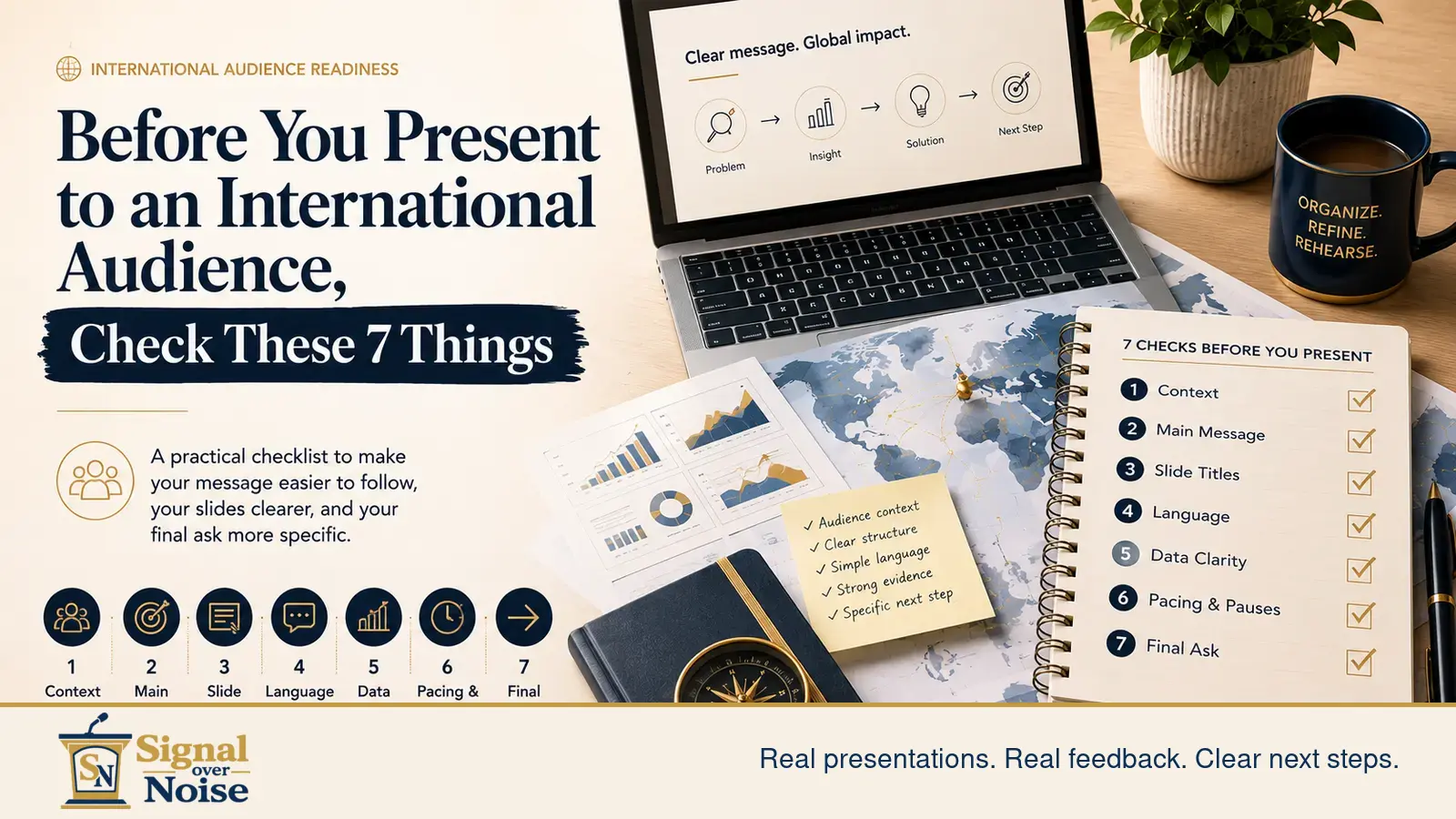
Before you present to an international audience, check these seven things so people can follow faster, trust the message sooner, and leave knowing what to do next.
Short answer: Before presenting to an international audience, make the context, main message, slide titles, language, numbers, pauses, and final ask easier to follow. The goal is to reduce the audience’s work, not to sound perfect.
The checks move from structure to language to evidence to the final ask.
1. Have you given enough context for the main point to land?
Local audiences fill in gaps quickly. International audiences often cannot.
If you say, “As everyone knows, this is a major issue in our market,” the audience may quietly think, “No, actually. We do not know that.”
That is not their failure. That is a setup problem.
The rule is not “give more background.” The rule is “give only the context needed for the main point to land.”
Before the main argument, give the audience the minimum useful context, not a full history lesson:
- What situation are we looking at?
- Why does it matter now?
- What has changed?
- Who is affected?
- Why should this audience care?
You do not need a long history lesson. You need a clean runway.
For example, if you are presenting a Korean pilot project to a European partner team, do not assume they know the local market pressure, approval process, or customer behavior behind your recommendation.
Weak setup:
This issue has become serious recently.
Stronger setup:
Over the past year, customer support requests have increased while response capacity has stayed almost the same. That gap is now creating delays for international clients.
The second version gives the audience something to stand on.
The audience does not need everything you know. They need enough context to understand why this point deserves attention now.
2. Is your main message obvious early?
Context helps the audience stand up. The main message tells them where they are going.
Many presentations make the audience wait too long for the point.
That is risky in any room. It is worse with an international audience because people are already spending extra energy decoding language, slides, accent, terminology, and context.
Do not hide the point like a plot twist.
A slow structure looks like this:
- background
- history
- market overview
- methodology
- main point
A stronger international-audience structure often looks like this:
- main point
- why it matters
- what evidence supports it
- what should happen next
By the first few minutes, the audience should understand:
- what you are talking about
- why it matters
- what you want them to believe, approve, understand, or do
A useful test:
If someone joined late and saw only slide three, would they know what this presentation is trying to prove?
If not, your structure may be too slow.
If the audience has to wait too long for the point, they start using energy on orientation instead of persuasion.
3. Are your slide titles doing real work?
A slide title should not just label the topic. It should help the audience follow the argument.
Generic slide title:
Market Overview
Useful slide title:
International demand is growing faster than our current support process can handle
Generic slide title:
Results
Useful slide title:
The pilot reduced manual reporting time, but onboarding is still the bottleneck
This matters because international audiences often rely heavily on slide titles. If the spoken explanation is fast, unfamiliar, or difficult to catch, the slide title becomes the backup navigation system.
This becomes even more important when the speaker has an unfamiliar accent, the room has mixed English levels, or half the audience is following through a remote call.
Make it useful.
A good slide title should answer one of these questions:
- What is the point of this slide?
- Why does this information matter?
- How does this slide move the argument forward?
If your titles are only labels, the audience has to build the logic themselves. That is unnecessary labor. Do not outsource your structure to tired people in a conference room.
4. Have you removed local idioms, inside references, and clever-but-risky wording?
This is where many strong presenters accidentally make things harder.
Idioms, jokes, sports references, company slang, regional examples, and clever phrases can work beautifully with the right audience. With an international audience, they can become fog machines.
Watch for phrases like:
- “move the needle”
- “low-hanging fruit”
- “table stakes”
- “ballpark number”
- “boil the ocean”
- “hit the ground running”
- “we’re not here to reinvent the wheel”
Some international audiences will understand them. Some will not. The bigger problem is that even when people roughly understand the phrase, it may still slow them down.
The problem is not that idioms are always wrong. The problem is that they create tiny delays at exactly the moment you need momentum.
A useful test: if a phrase would be hard to translate directly into another language, check whether a simpler version would do the job better.
Plain language is not childish. Plain language is efficient.
Instead of:
We need to move the needle on customer retention.
Try:
We need to increase customer retention.
Instead of:
This is table stakes for global expansion.
Try:
This is a basic requirement for global expansion.
Simple wins. Especially when the stakes are high.
5. Can the audience understand the numbers without extra explanation?
Numbers are not automatically clear.
A chart can be technically accurate and still fail because the audience does not know what to look at, what changed, or why the number matters.
Before presenting data internationally, check:
- Is the unit clear?
- Is the timeframe clear?
- Is the comparison clear?
- Is the source or basis clear enough?
- Is the takeaway written directly on the slide?
For international audiences, also check for hidden confusion:
- Are currencies clearly labeled?
- Are units familiar or explained?
- Are dates written in an unambiguous format?
- Is the percentage attached to a clear baseline?
- Is the market comparison obvious to people outside your country?
Do not just show the number. Interpret it.
Weak version:
Revenue increased by 18%.
Stronger version:
Revenue increased by 18%, mainly from repeat customers in two export markets.
Even stronger, with baseline clarity:
Revenue from repeat export customers increased by 18% compared with the same quarter last year, making this group our strongest source of growth.
The number is not the message. The meaning is the message.
6. Have you planned for slower listening and better pauses?
International presentations often need slightly more air.
A pause is not empty space. For an international audience, it is processing time.
That does not mean speaking painfully slowly. It means giving the audience enough time to process important ideas.
You need pauses after:
- the main point
- important numbers
- slide transitions
- technical terms
- recommendations
- the final ask
A common problem is that presenters practice by reading the script smoothly from beginning to end. That feels fluent, but it often lands too fast.
Practice it like this:
- Say the recommendation.
- Pause.
- Say the reason.
- Pause.
- Say the risk.
- Pause.
- Then move to the evidence.
That rhythm gives the audience time to understand the logic instead of chasing it.
For example:
The recommendation is simple.
We should expand the pilot to two additional teams before making a company-wide decision.
The reason is risk.
The pilot results are promising, but the onboarding process is not ready yet.
Those pauses help the audience follow the argument.
They also make the presenter sound more confident. Rushing usually sounds nervous, even when the content is strong.
7. Is your final ask specific enough?
A lot of presentations end with polite fog.
Thank you for listening. We welcome your feedback.
That may be appropriate in some academic or ceremonial settings. But in many business, pitch, proposal, or project presentations, it is too vague.
Before you present, define the actual next step.
Usually, the ask falls into one of four categories:
- Decision ask: approve, fund, choose, reject, prioritize
- Input ask: review, challenge, give feedback, identify risks
- Relationship ask: introduce, connect, schedule, refer
- Alignment ask: agree on the problem, confirm priorities, choose the next discussion
Are you asking the audience to:
- approve a pilot?
- fund the next phase?
- choose between options?
- give technical feedback?
- introduce a partner?
- review the proposal?
- align on the problem?
- schedule a follow-up discussion?
Then say it clearly.
Weak ending:
We hope this gives you a good understanding of our project.
Stronger ending:
Today, we are asking for approval to run a four-week pilot with one overseas partner team. After that, we will report the results and recommend whether to expand.
The audience should not have to guess what you want.
A specific ask does not make you pushy. It makes the meeting usable.
A 10-minute international presentation rescue checklist
If you only have 10 minutes before the meeting, check these in order:
- [ ] Is the main message clear within the first few minutes?
- [ ] Did I give enough context for the main point to land?
- [ ] Is my final ask specific?
- [ ] Do my slide titles explain the point, not just the topic?
- [ ] Are my numbers easy to understand and clearly interpreted?
- [ ] Did I remove idioms, local references, and unnecessary clever wording?
- [ ] Have I practiced pauses after important ideas?
If you checked all seven, your presentation is probably much easier to follow.
If two or three of them feel shaky, that is where to focus first.
The real test
An international audience does not need you to sound perfect.
They need you to be easy to follow, easy to trust, and clear about what happens next.
That usually comes from better structure, cleaner slide titles, simpler language, stronger context, and more deliberate delivery.
Not more decoration.
Not more slides.
Definitely not another “market overview” slide quietly committing crimes in the middle of the deck.
If two or three of these checks feel shaky, do not try to fix everything at once. Start by finding the one place where the audience has to work too hard.
If you are preparing an English or international-facing presentation and you are not sure what to fix first, start with the material you already have. Send the deck, outline, or script and get a focused Free Presentation Diagnostic.
The goal is simple: find the part of the presentation that is making the audience work too hard, then fix that first.