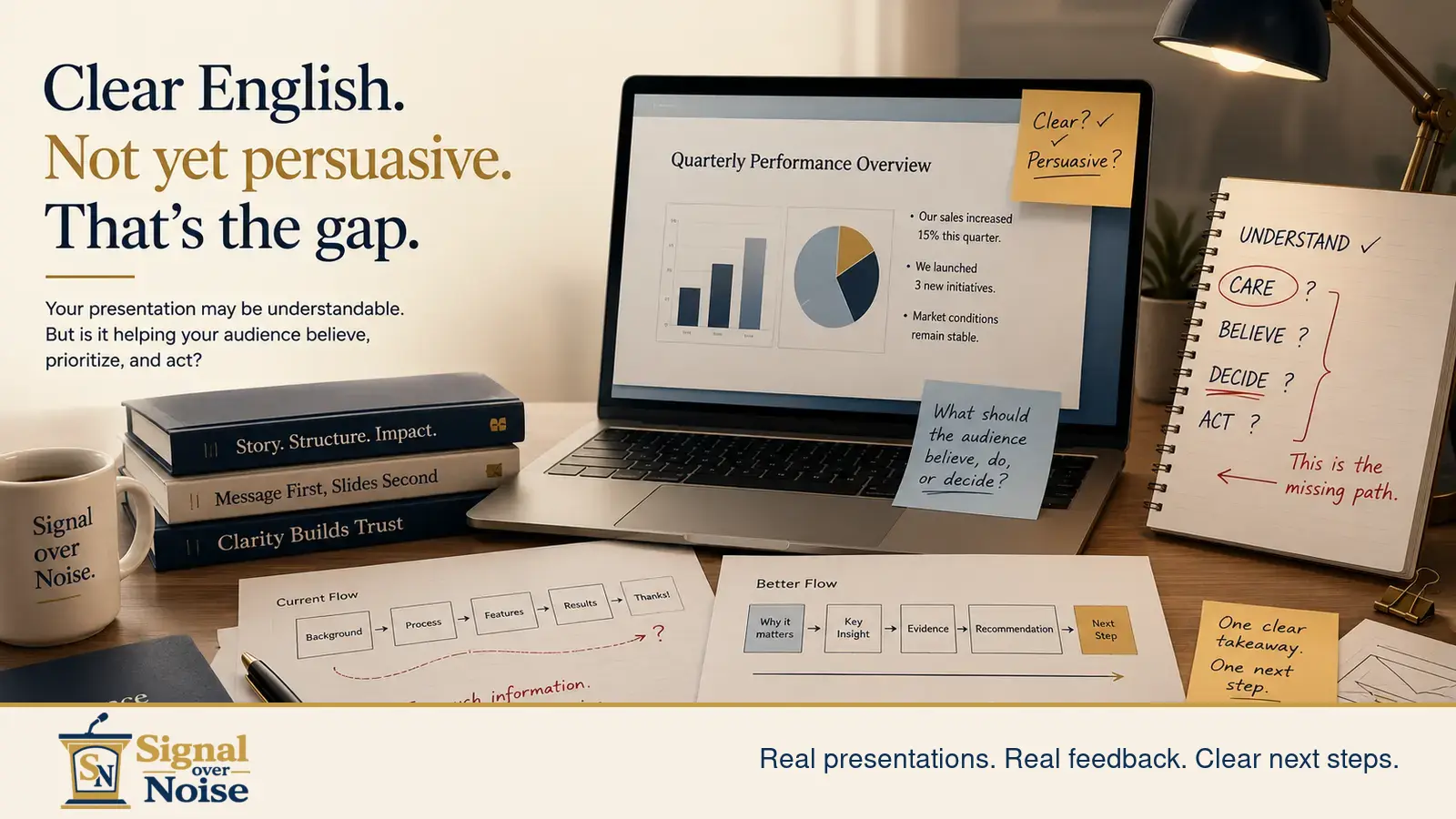
Your English presentation can sound clear and still not persuade anyone.
That is the annoying part.
The audience understands the words. They follow the slides. They may even nod politely. But when the presentation ends, they are not convinced, not aligned, and not ready to act.
That usually does not mean your English is bad.
It means the presentation is doing the easier job: explaining. It is not yet doing the harder job: moving the audience toward a decision.
This matters most when the presentation is not just a language task, but a business, academic, or professional decision moment.
Here are five signs your English presentation sounds clear, but still does not persuade.
Quick version: If your audience understands your presentation but does not act, the problem is usually not English accuracy. It is often a missing takeaway, weak stakes, low audience relevance, a buried recommendation, or no next step.
The problem: clear is not the same as convincing
A clear presentation helps people understand what you are saying.
A persuasive presentation helps people understand why it matters, why now, why this option, and what they should do next.
Those are different jobs.
This is especially easy to miss when you are presenting in English as a second language. You may spend so much energy making the language accurate, polite, and understandable that the argument gets too soft.
The grammar works. The slides make sense. The audience follows along.
And still, they leave thinking, “Okay… so what?”
Not ideal. Tiny problem. Only the whole point of the presentation.
Sign 1: Your audience knows the topic, but not the takeaway
A topic tells the audience what the presentation is about.
A takeaway tells them what they should believe, notice, support, change, or decide.
For example:
This presentation is about our new onboarding system.
That is clear. It is also weak.
A stronger version sounds more like this:
Our current onboarding process is slowing down new hires, and the new system gives managers a faster, more consistent way to get people productive.
Now the audience has something to evaluate.
The problem is not that the first version is wrong. It is just incomplete. It names the subject, but it does not create a reason to care.
What to fix
Before you polish the slides, write the main point in one sentence:
Because [problem or change], [audience] should [decision or action] so that [specific benefit or risk avoided].
For example:
Because our overseas clients need faster technical answers, the support team should adopt the new response template so we can reduce delays and protect renewal conversations.
That sentence may not appear exactly on a slide. Fine. It still gives the whole presentation a spine.
Sign 2: You explain the process before the stakes
Many clear presentations in English start like this:
- Background
- Timeline
- Process
- Features
- Results
- Recommendation
It feels organized. It is also often backwards.
If the audience does not yet understand the stakes, the process details feel like homework. They may understand the information, but they do not know how to weigh it.
This is where a lot of technical, academic, and startup presentations lose people. The presenter is trying to be thorough. The audience is trying to figure out why any of this matters.
The fix is not to remove all detail. The fix is to give the detail a job.
Instead of opening with:
First, let me explain our research method.
Try:
Our current process is delaying client responses by almost two days. We looked at where the delay starts, and one issue stood out.
The first version explains the process.
The second version gives the audience a reason to care about the process.
What to fix
Move the stakes earlier.
Try this order:
- What changed or what is at risk?
- Why should this audience care?
- What did we find or build?
- What does the evidence show?
- What should happen next?
Process is useful after the audience knows why the process matters.
Sign 3: Your slides answer “What is it?” but not “Why should I care?”
Sign 1 is about the presentation as a whole. This sign is about what happens slide by slide.
Your slides may look clean. They may even be easy to follow.
The audience sees:
- a product overview
- a research summary
- a feature list
- a market slide
- a timeline
- a comparison chart
All understandable.
But each slide is only answering the first question: What is this?
Persuasion needs the second question: Why should this audience care?
A product slide should not only explain the product. It should show why the product matters to the buyer, partner, investor, department head, professor, committee, or client in the room.
A research slide should not only summarize findings. It should show what those findings change.
A market slide should not only show size. It should show why this specific opportunity is worth attention now.
What to fix
For every important slide, ask:
What does this slide help the audience decide, trust, remember, or do?
If the answer is “it gives information,” the slide probably needs a sharper role.
Information is not bad.
Information without a job is the problem.
Sign 4: Your language is accurate, but your recommendation is buried
Polite English can become a hiding place.
You may say:
We would like to suggest that this option may be considered for future improvement.
That is grammatical. It is also wearing three sweaters and hiding behind a curtain.
In many professional settings, especially cross-cultural ones, presenters soften their language because they do not want to sound aggressive. Sensible. But if the recommendation becomes too soft, the audience cannot tell what you actually want them to do.
You do not need to sound pushy.
You do need to sound responsible.
What to fix
Replace vague suggestion language with clear recommendation language:
| Too soft | Clearer |
|---|---|
| This could be considered. | We recommend testing this in one team first. |
| It may be useful to think about. | The next step is to compare these two options. |
| We hope this can support improvement. | This gives us a clearer way to reduce the delay in the current process. |
| There are some possible benefits. | The strongest benefit is faster decision-making. |
Good persuasion is not shouting.
It is making the audience’s next decision easier to see.
Sign 5: You end with thanks instead of a next step
A weak ending can erase a strong presentation.
Many English-language presentations end with:
Thank you for listening. Do you have any questions?
That is polite. It is also not a close.
If the presentation had no decision attached, this may be enough. But if you are pitching, proposing, defending research, asking for approval, requesting support, or trying to move an international audience toward action, you need a stronger final move.
The ending should remind the audience what matters and name the next step.
What to fix
Use a three-part close:
- The situation: What is the key issue or opportunity?
- The recommendation: What should happen next?
- The ask: What do you want from this audience?
For example:
Our current onboarding process is creating delays for new team members. We recommend piloting the new system with the overseas sales team first. Today, we are asking for approval to run that pilot in July and report the results after four weeks.
That ending gives the audience something to respond to.
Which is useful. Because “That was clear” is not the same as “Yes.”
Quick diagnostic checklist
Use this before your next presentation in English:
- [ ] Can the audience repeat your main takeaway, not just your topic?
- [ ] Do you explain why the issue matters before giving process details?
- [ ] Does each important slide answer “why should this audience care?”
- [ ] Is your recommendation clear, or is it buried in soft language?
- [ ] Does your ending name the next step or ask?
How to read your score
If you checked 0–1 boxes, start with the main takeaway and recommendation. Those are likely your highest-leverage fixes.
If you checked 2–3 boxes, the structure is close, but the recommendation or stakes may need sharpening.
If you checked 4–5 boxes, the argument has a strong base. Your next improvement may be delivery, slide design, or stronger evidence.
What to fix first
Do not start by rewriting every sentence.
Start with the argument.
Write these three lines before editing the deck:
The audience needs to understand that: [main point]
The audience needs to believe this because: [reason/evidence]
The audience should do next: [decision/action]
Then check whether your opening, slide titles, examples, and ending all support those three lines.
If they do, your English does not need to be fancy. It needs to be clear, specific, and pointed at the right decision.
That is the difference between a presentation that sounds understandable and one that actually lands.
Next step
If your English presentation sounds clear but still is not landing, start with the Free Presentation Diagnostic. Send one piece of real material: your deck, script, outline, or a short practice video.
You will get practical expert feedback on what is blocking clarity, credibility, or persuasion, and the next useful fix.
No vague advice. No confidence theater. Bring the actual material. We will work from what is really there.